-
I.21 — The Alignment Trap: When Agreement Is the Warning, Not the Win
“For the most part we do not first see, and then define, we define first and then see.” — Walter Lippmann, Public Opinion The leadership team reaches agreement in twenty minutes, and everyone feels the relief of it. Heads nod. The tension that walked in has dissolved. Someone says the sentence that always gets said…
-
I.20 — The Question They Never Heard Before: How Surprise Restarts Thought
“The only true voyage of discovery would be not to visit strange lands, but to see with other eyes.” — Marcel Proust, La Prisonnière Walk into a recurring strategy meeting and you can watch a room decide nothing, fluently. The agenda is familiar. The issues are known. The dialogue is smooth. The head of sales…
-
I.19 — The Question Has Altitude: Don’t Solve Strategy in an Ops Room
“It is not enough to be industrious; so are the ants. What are you industrious about?” — H. D. Thoreau Many decisions fail not because the idea was wrong, but because the wrong room tried to do the wrong kind of deciding. You demand operational certainty before you will approve a strategic direction. Or you…
-
I.18 — The Hidden Question: What the Room Is Negotiating
“People are not against you; they are for themselves.” — a maxim of negotiation A room can debate for ninety minutes and never touch the thing it is negotiating. The slides are clean, the arguments intelligent, the data abundant, and nothing resolves. Not because the people are irrational, but because the question on the table…
-
I.17 — The Question Is a Control Object: Design, Not Wording
“The mere formulation of a problem is far more often essential than its solution.” — Albert Einstein A question is not a sentence you ask. It is a designed object that determines what can be seen, what counts as proof, how fast you are allowed to move, and which trade-offs are even permitted. Most bad…
-
I.16 — The Strategy Mirage: Confusing Capability With Purpose
“When a man does not know what harbour he is making for, no wind is the right wind.” — Seneca Every few years, institutions fall in love with a tool and mistake it for a destiny. “Digital transformation” becomes the strategy, then “cloud,” and now “AI.” The pattern is predictable. The capability feels concrete, modern,…
-
I.15 — Desire: The Force Beneath Utility
“Desire is the very essence of man.” — Baruch Spinoza, Ethics Picture a standard executive decision meeting. The table is covered in the artifacts of rationality: spreadsheets, risk matrices, projections. To an observer it looks like a laboratory, a group of neutral sensors receiving data and processing it into a logical output. To anyone who…
-
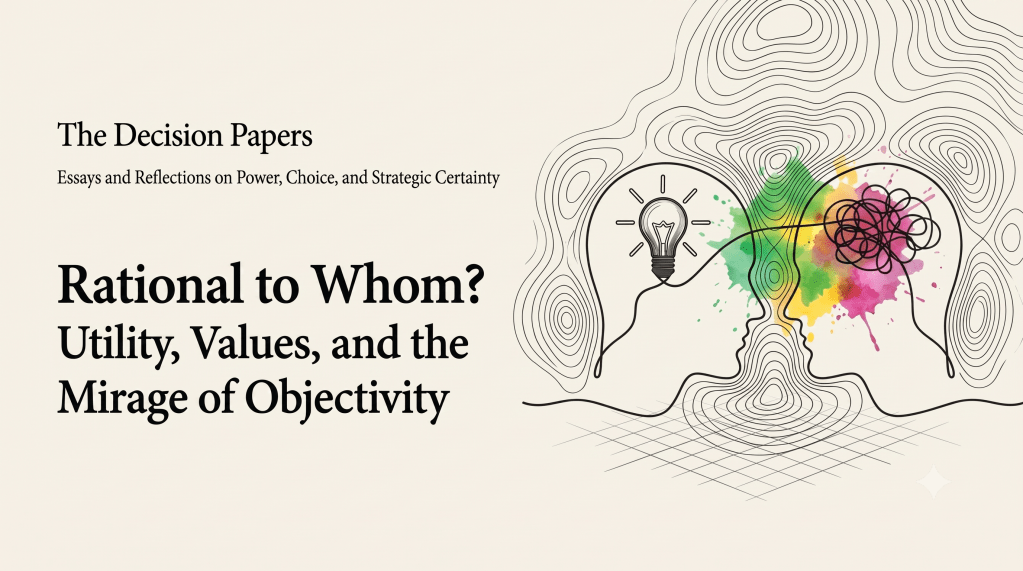
I.14 — Rational to Whom?: Utility, Values, and the Mirage of Objectivity
“There are no facts, only interpretations.” — Nietzsche In every high-stakes project there comes a moment of exasperation when a leader calls a colleague, client, or regulator “completely irrational.” The phrase offers a dangerous mix of frustration and comfort. It performs a quiet exit. By ruling the counterparty a malfunction rather than an actor with…
-
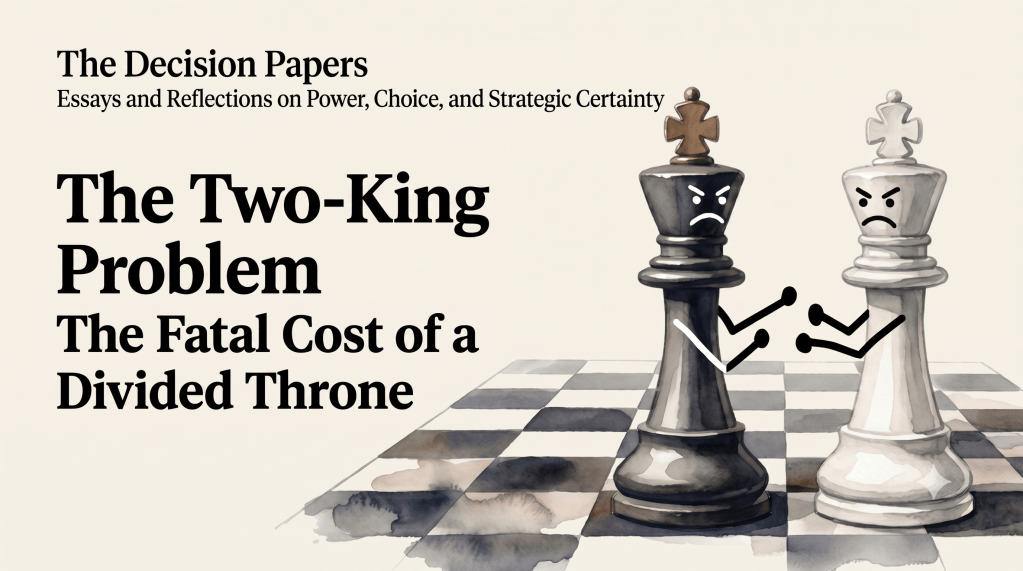
I.13 — The Two-King Problem: The Fatal Cost of a Divided Throne
“The same attribute cannot at the same time belong and not belong to the same subject in the same respect.” — Aristotle Most organisations know they should not operate without a strategy. Fewer recognise the subtler and more fatal trap: holding two strategies that contradict each other, and refusing to choose between them. Call it…
-
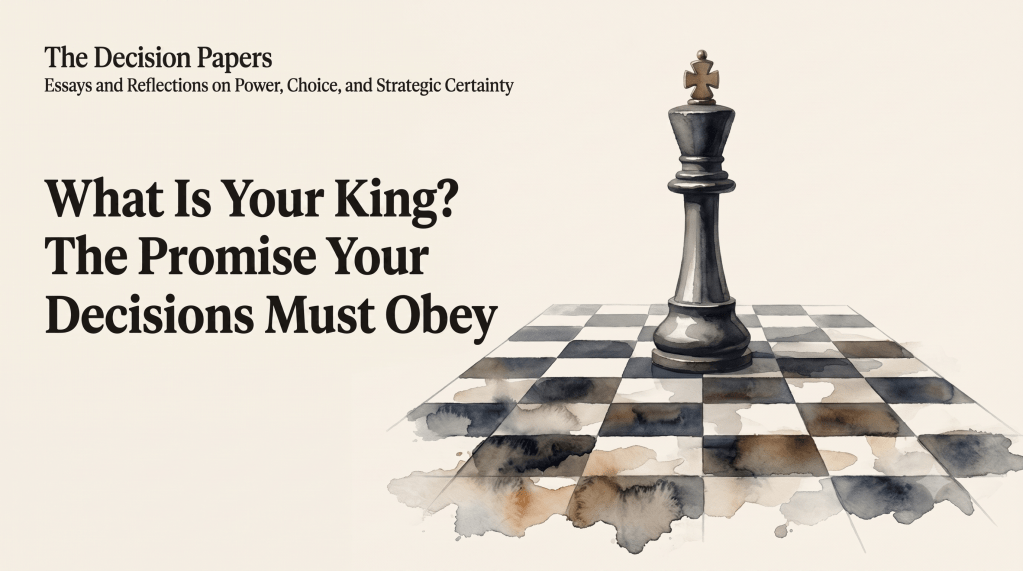
I.12 — What Is Your King? The Promise Your Decisions Must Obey
“The center of gravity is the hub of all power and movement, on which everything depends; that is the point against which all our energies should be directed.” — Carl von Clausewitz In chess, a player can win pieces, control the centre, dominate the board, and look brilliant doing it, and still lose, because they…
-
Subscribe
Subscribed
Have a WordPress.com account? Log in now.

