“For the most part we do not first see, and then define, we define first and then see.”
— Walter Lippmann, Public Opinion
The leadership team reaches agreement in twenty minutes, and everyone feels the relief of it. Heads nod. The tension that walked in has dissolved. Someone says the sentence that always gets said here, satisfied: I’m glad we’re all aligned. And that sentence, right there, is the most dangerous thing said in the room all day.
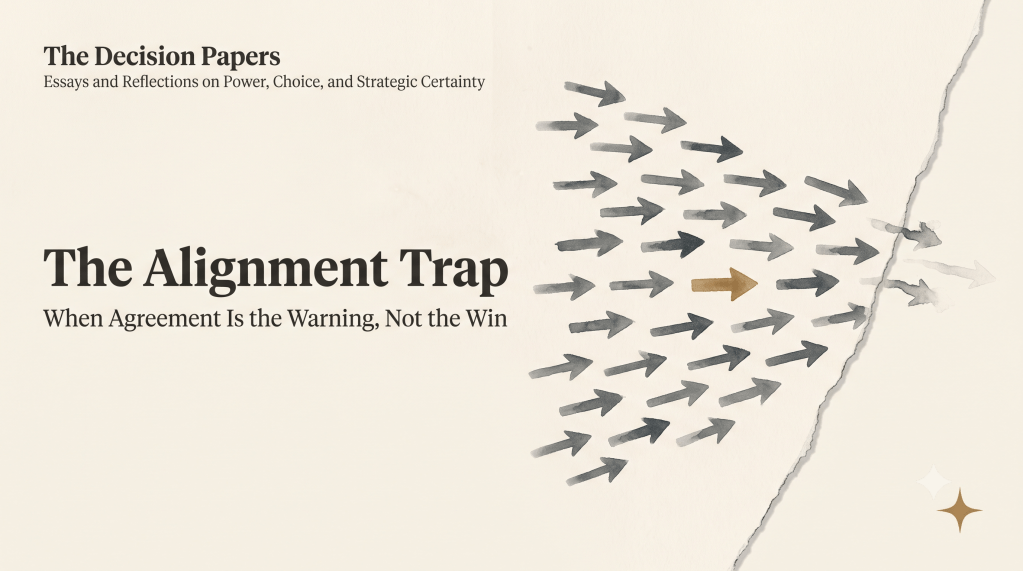
Because alignment measures agreement. It does not measure whether you are right. A room can be fully aligned and fully wrong, and from the inside they feel identical: the same nodding, the same relief, the same consensus. Call it the Alignment Trap. You converge on a direction, mistake the converging for having tested it, and set off together in perfect formation. Picture the herd streaming across the ice, flank to flank, aligned, pouring over the cliff edge in a single arc. Cliff Consensus. Everyone agreed. Everyone was wrong. Look for the one animal facing the other way, planting its feet, refusing to move. You will not find it. That absence is the whole disaster.
And this belongs at the question, upstream, not later. Alignment does its damage before the plan exists, at the moment the room settles on what it is even trying to decide. Once the room has agreed on the question, the dissent that would have tested it has nowhere left to go. The execution can be flawless. The cliff was upstream, in the frame the room aligned on before anyone stressed it.
So why does a room align so fast? The easy answer, that agreeing is comfortable and dissenting is expensive, is true but only the surface. Underneath, the room aligns fast because the answer is recognisable. Call it the Inherited Frame: the mental model an organisation carries from its past, through which it reads every new problem. You believe you are designing a future. You are mostly aligning around the boundaries of your own imagination. You ask new questions in old language. You measure new work with old metrics. You picture new solutions as upgrades to the machinery you already own. So alignment forms around the familiar, not the necessary, and no one notices, because the familiar is exactly what does not draw attention.
The Inherited Frame protects itself in ways that feel like virtue. The word realistic is its favourite guard: a new idea is not rejected as false, it is rejected as unrealistic, and the box gets to wear the face of prudence and discipline. Memory does the rest. Institutional memory is precious when it preserves lessons and dangerous when it preserves fear, and over time you stop asking what is now possible and start asking what has survived here before. That is the quiet substitution at the heart of the trap: familiarity masquerading as coherence. Everyone aligns, fast and warmly, not because the answer is right but because it is recognisable, and recognition feels so like agreement that no one checks which is in the room.
This is worse than open disagreement, not better. A divided room still has the doubt in it, available. An aligned room has spent the doubt, trading the one input that could have caught the cliff, informed dissent, for the warm feeling of a room at peace. And because alignment feels like an achievement, you start to chase it, scoring the meeting by how aligned it ended. That crowns a proxy: agreement standing in for judgment. Worse, it crowns the old system as the real sovereign, because the inherited frame is what the alignment keeps forming around. Optimise for that, and you do not merely miss the error. You build a room that manufactures it, at speed, with confidence, and calls the confidence teamwork.
The frame defends itself at the level of people, too. The person who can see the box, who asks in new language, gets filed as naïve or impractical, insufficiently aware of how things work here. So the organisation does not merely fail to think past its frame. It grows antibodies against the people who can. That is when legacy stops being memory and becomes self-protection, and the one voice that might have turned the herd gets managed out for being difficult.
None of which means the past is the enemy, or that disagreement is the goal. A room that never aligns cannot move, and experience often is exactly the prudence it claims to be. The test is not whether the frame is old. It is whether it is preserving a lesson or preserving a fear. So the fix is alignment in the right order. Align late on the question, only after the frame has taken some fire. Align fast on execution: once the direction is set, disagree, commit, and go. The danger is never alignment. It is premature alignment around an inherited answer, and a fast, warm consensus is the flag that you may be looking at one.
So you engineer the dissent back in, and the Inherited Frame makes one thing essential: it has to come from outside the frame. Dissent from people steeped in how things work here only produces the past agreeing with itself. Gather the judgments independently first, before the room converges, because a view offered early is real and the same view asked for after everyone has nodded is only a courtesy. Give one person standing to argue not that the answer is wrong but that it is merely inherited, with real authority to hold the frame open. And keep apart the two questions the trap collapses into one. Do we agree on the question? Do we agree on the route? Align on the route freely. Do not align on the question until it has survived someone from outside the frame truly trying to break it.
An organisation cannot align beyond the size of its imagination, and when the past decides what is thinkable, alignment becomes obedience to it. So the next time a room clicks into agreement and someone says how aligned you all are, do not relax. That is the moment to look at the edge, and to ask whether you chose this direction or only recognised it. Check the direction before you admire the formation, because a herd in perfect step is not proof the step is safe. It is only proof that no one is looking sideways.
Decision Rule — The Dissent Check
When agreement on the direction comes fast and clean, stop before you commit and test what produced it.
- The flag. Did the room align quickly and comfortably? Treat that ease as a signal to check, not a result to celebrate.
- The inherited frame. Is this answer recognisable rather than right, an upgrade to machinery you already own? Are you asking what is now possible, or what has survived here before?
- The outside voice. Gather the key judgments independently, before the room converges, and give someone standing to argue that the frame is merely inherited.
- The two questions. Separate agreement on the question from agreement on the route. Align late on the first, fast on the second.
If no one can say what the room disagreed about, the room did not decide. It conformed.
Read unanimity as a question, not an answer.


Leave a Reply