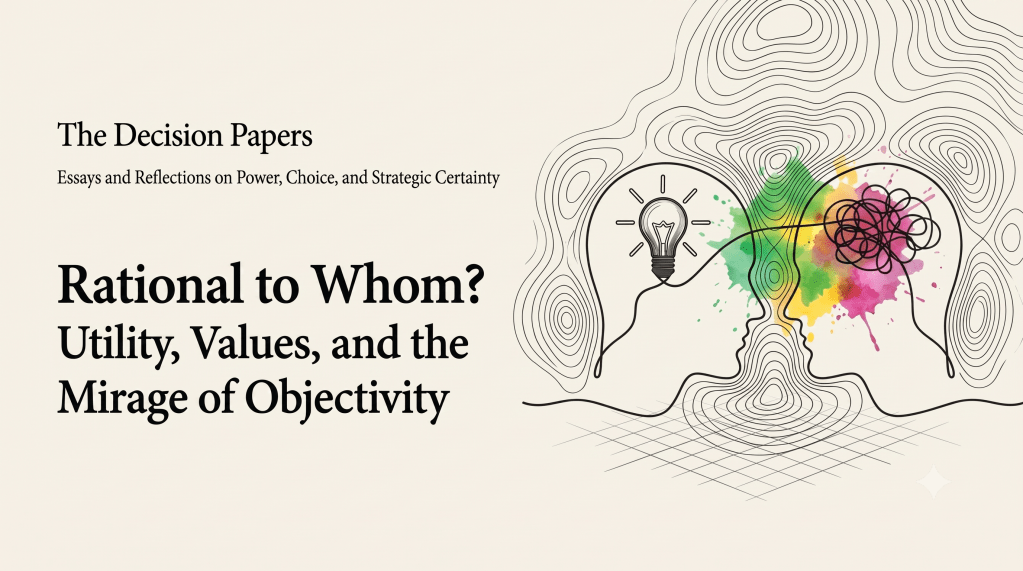
“There are no facts, only interpretations.”
— Nietzsche
In every high-stakes project there comes a moment of exasperation when a leader calls a colleague, client, or regulator “completely irrational.” The phrase offers a dangerous mix of frustration and comfort.
It performs a quiet exit. By ruling the counterparty a malfunction rather than an actor with an objective, the leader is excused from the harder work of understanding them. The verdict flatters: we stand on the solid ground of truth while they drift in delusion.
But genuine irrationality is rare in executive settings. What looks like madness is almost always rationality disconnected from your assumptions. The error is not theirs. It is yours, for measuring their decision with your ruler.
Rationality is not a universal substance. It is goal-aligned behaviour under constraints, and the goals are not the same across the table.
The precise name for the thing that differs is the utility function: shorthand for what an actor is optimising, whether growth, control, reputation, or survival. When two people serve different beneficiaries, time horizons, or loss conditions, their rational moves diverge, not because one is thinking poorly, but because each is solving a different problem.
Seal this off from a true failure of intelligence, because they are constantly confused. A failure of intelligence is a broken inference: the actor reasons badly toward their own goal. A difference of utility is sound reasoning toward a different goal. The first is a defect. The second is a disagreement passing itself off as a defect.
The mechanism is straightforward once the utility function is in view.
If a chief executive values short-term share price above all else, gutting research and development is destructive, and perfectly rational within that frame. The act is not evidence of stupidity. It is evidence of what is being optimised.
So the friction in the boardroom is rarely about logic. It is about the function each party is solving. Argue with data about growth to someone solving for control, and your logic may be flawless and entirely beside the point.
Behind most “irrational” moves sits a hidden force the other party can see and you cannot: a shorter horizon, a lopsided share of the risk, a threatened status. The department head who burns the year-end budget looks wasteful until you see the King being protected, next year’s capacity, which makes the spending coherent.
The deeper danger is not misreading them. It is mistaking your own utility function for objective truth.
We dress value weights as laws of physics. Efficiency, ROI, speed, these are preferences with priorities attached, not universal constants. When a leader presents a preference for speed as “just the logical thing to do,” they are engaged in rationality laundering: scrubbing a private desire until it looks like a public fact. It is a power move, because it reframes dissent as incompetence rather than as a legitimate difference in what to value. An institution that cannot tell its preferences from its proofs will keep mistaking the people who disagree for the people who cannot think.
None of this means every actor is rational and judgment must be suspended. That is the opposite error, and a real one.
Genuine irrationality exists, panic, impairment, bad faith, and treating every destructive act as a clever move in a frame you have not yet found is its own naïveté. The discipline is not to excuse. It is to sequence. Translation comes first: model the utility function until the behaviour becomes coherent. Then judgment comes second, on firmer ground, because now you are judging the right thing. Some functions, once understood, are ones you can negotiate with. Others are ones you must defeat. You cannot tell which until you have done the modelling, and the verdict of irrationality skips the modelling entirely.
So the move is from judgment to translation, and it has a concrete trigger.
Treat the word “irrational” as a warning light. It does not describe the other actor; it reports that you have not yet modelled their constraints. The instant you reach for it, stop and ask the translation question: what would have to be true about their world, their King, their risks, their timeline, for this choice to be the smartest move on the board?
If you can answer, you have found the function they are solving, and you can negotiate the trade-off, because trade-offs between understood positions are tractable. If you cannot answer, you do not yet understand the decision you are judging, and your verdict is premature.
Consider the regulator who blocks an approval everyone in the room considers obviously safe. Labelled irrational, the behaviour stays opaque; modelled, it resolves at once. The regulator is not optimising for this product’s expected value. They are optimising against the one catastrophic approval that would end a career and indict an agency, and against that loss function a delay that looks paranoid from inside the company is the dominant move. Once the function is named the negotiation becomes tractable: you stop arguing that the risk is small and start addressing the exposure that is driving them.
There is a sharper use still. Every decision a leader makes is itself a signal of utility, teaching the organisation what is rewarded. Preach innovation and fire the first person who fails, and the organisation quietly updates toward safety, whatever the posters say. The real King is revealed by what survives pressure, not by what is declared in calm.
Before you call a choice irrational, model the function it serves. Disagreement over values is not a failure of intelligence, and your own preferences are not the structure of reality.
Translate first. Judge second. And never let your ruler crown itself the measure of the world.
No one is irrational inside their own frame; before you call a choice mad, find the King it serves and the horizon on which it is the smartest move on the board.
Decision Rule — The Frame Audit
Before labelling any choice irrational, model the actor before you judge them.
- The King. What is this actor protecting, fearing, valuing, or unable to afford to lose?
- The frame. What would have to be true about their horizon, risk, and constraints for this choice to be the smartest move on the board?
- The verdict. Once the choice is coherent, is this a utility function you can negotiate with, or one you must defeat?
If you cannot make the choice coherent, you do not yet understand the decision you are judging, and your verdict is premature.
Before you call it irrational, ask what King it serves.


Leave a Reply