“Desire is the very essence of man.”
— Baruch Spinoza, Ethics
Picture a standard executive decision meeting. The table is covered in the artifacts of rationality: spreadsheets, risk matrices, projections.
To an observer it looks like a laboratory, a group of neutral sensors receiving data and processing it into a logical output. To anyone who has lived in that room, it is often theater. The decision has, in large part, already been made, not by the spreadsheet, but by a current running beneath the table.
That current is desire, present before the first slide was built. One leader wants the acquisition because it signals growth. Another wants to kill the project because it threatens headcount. The question no one asks is which pull is steering the analysis.
This is the relationship most decision-making gets backward. Utility is the output, not the input.
In economics, “utility” is the clean mathematical apparel we put on messy impulses to make them look like settled preferences. But the preference is downstream. The input is a raw directional pull, a desire with both a direction and a force, and the utility function is what that pull looks like after it has been formalised.
Seal this off from ordinary preference, because they are easily confused. A preference is a stable ranking an actor can state and defend. A desire is the live pull that bends which preferences get formed in the first place. The danger is not that leaders have desires. It is that the desire arrives disguised as the analysis, so the room debates the outfit and never sees the body wearing it.
The mechanism is concrete. An active desire does three things before any data is examined.
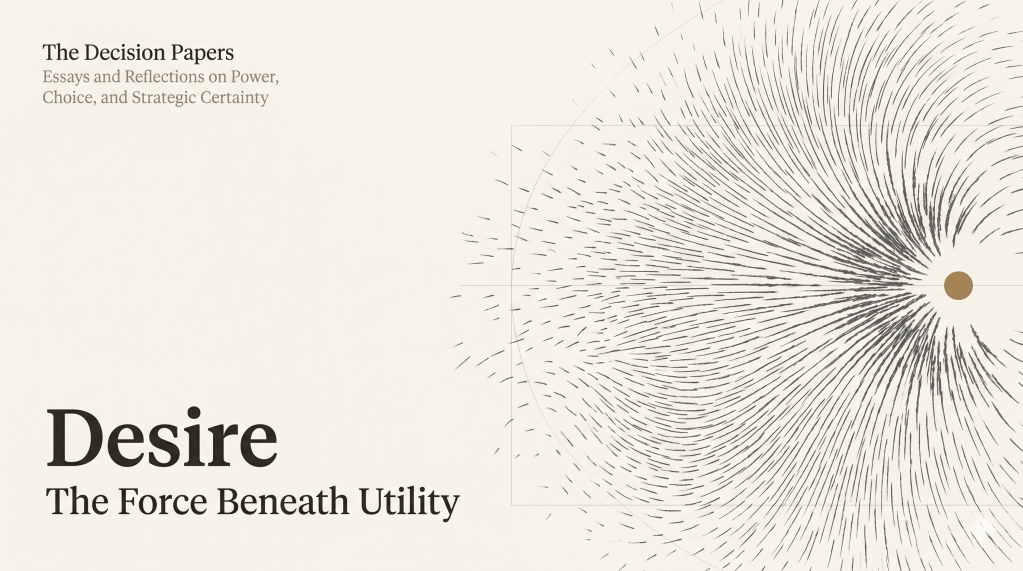
It sets the frame, deciding what the decision is even about. It selects the time horizon, choosing whether next quarter or next decade is the measure. And it determines which trade-offs are visible and which stay hidden. The data then arranges itself around a destination that was chosen before the data arrived, the way iron filings align to a magnet held beneath the page.
This is objectivity laundering. The mind takes the raw pull, “I want to do this”, and scrubs it until it reads as an imperative, “the analysis demands this.” By the time the deck reaches the board, the desire speaks the language of the institution’s mission, and the disguise is seamless because the want underneath is rarely a crude grab for money or turf. It is a need the actor can barely admit to himself: safety from blame, standing among peers, control, the shape of a legacy. Mission-language is the perfect carrier precisely because “I must protect the institution” is, from the inside, indistinguishable from “I must protect myself.”
The most insidious move is at the level of proof. Desire does not just select the evidence. It sets the standard the evidence must clear, and it sets a different standard depending on which way it pulls.
When we want an outcome, we ask, can I believe this? We look for permission, and a single favourable data point feels like enough. When we do not want an outcome, we ask, must I believe this? We look for compulsion, and we raise the bar to the ceiling.
This is why two capable leaders read the same report and reach opposite conclusions. They are not analysing the data. They are auditing it against a desire, one looking for a reason to say yes, the other for a reason to say no, each certain they are simply being rigorous.
The objection is that desire is also the engine of leadership, and interrogating every pull would be its own failure.
This is true, and it matters. Desire is the source of conviction, of vision, of the will to commit before the evidence is complete, which is most of the time. A leader who dissolves every pull into neutrality does not become objective. They become inert, incapable of the directional bet the role exists to make. So the discipline is not to suppress desire. It is to declare it. Desire is not the enemy; disguise is. A named pull can be weighed against the institution’s mandate and tested against the evidence. An unnamed one governs from underneath, unchecked, while everyone stares at the spreadsheet.
Declaration is the operational move, and it is a single sentence asked before the analysis hardens.
What outcome are we hoping for, and what would reality have to show us to accept a different one? The first half surfaces the hidden vector. The second half is the discipline, because it forces the room to name, in advance, the disconfirmer, the evidence that would change the decision, before anyone has become invested in the answer.
This converts objectivity from a costume back into a practice: a stated relationship with evidence rather than a word draped over a preference. The FDA’s 2021 approval of Aduhelm shows the cost of skipping it. The decision drew sharp criticism, including resignations from the agency’s own advisory committee, for clearing the drug on a surrogate marker rather than demonstrated clinical benefit. To those critics, beneath the technical language of endpoints and surrogate markers ran a powerful moral pull, the urgency to do something for millions of patients, a desire that did not present as emotion but wrapped itself in regulatory science and appeared to lower the evidentiary bar while still sounding rigorous. On that reading, the destination was chosen first and the scientific language recruited to certify it afterward.
Name the pull, and the certification can be audited. Leave it unnamed, and the room will keep mistaking the strength of its wanting for the weight of its evidence.
So before the deck is built, say what you hope it will conclude, and say what would make you abandon that hope.
Desire decides first and reasons second. The only question is whether you let it do so before the room, where it can be governed, or in the dark, where it governs you.
Desire that goes unnamed does not wait its turn; it decides first, then dresses the decision in the language of reason.
Decision Rule — The Pull Card
Before building the case, surface the pull and price it against the evidence.
- The hope. What outcome are we hoping for, stated plainly, before the analysis?
- The disconfirmer. What would reality have to show us to accept a different one?
- The threshold. Are we demanding more proof to say no than to say yes, or the reverse?
If the room cannot name the disconfirmer, it is not making a decision. It is certifying a hope.
Name the pull before you trust the proof.


Leave a Reply