“People are not against you; they are for themselves.”
— a maxim of negotiation
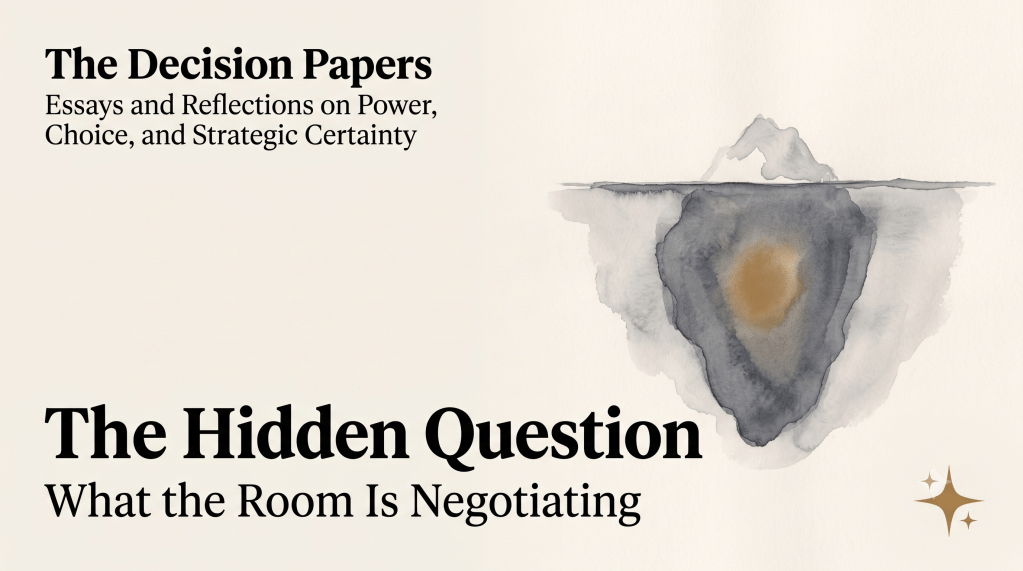
A room can debate for ninety minutes and never touch the thing it is negotiating.
The slides are clean, the arguments intelligent, the data abundant, and nothing resolves. Not because the people are irrational, but because the question on the table is not the question being decided.
The real one sits underneath. And if you answer the stated question perfectly, you may still lose the room, because the room was never asking it.
Call it the hidden question, and resist the easy version of what it is.
The easy version says people are hiding their feelings, that beneath the analysis lies anxiety or ego. Sometimes. But the sharper and more useful truth is structural, not emotional. The hidden question is usually about incentives: who carries the risk, who loses authority, who gets audited, who is exposed if this goes wrong.
That distinction matters because it changes the cure. If the obstacle were emotion, you would manage the person. Because the obstacle is usually incentive, you have to see the structure, the actual distribution of risk and reward around the table, that is making a rational person resist.
Here is what that looks like in practice.
A security officer blocks a product launch over a minor compliance ambiguity, delaying revenue for months. The stated question is whether the risk is acceptable. Everyone argues risk data, and the data does not move him.
It does not move him because risk was never the obstacle. Look at the structure: if he approves the launch and it breaks, he is fired. If he blocks it and revenue stalls, someone else misses a bonus. He carries all of the downside and none of the upside.
He is not being irrational or fearful. He is optimising precisely for his own survival, and calling it prudence, because prudence is the only language the meeting will accept. No quantity of risk data resolves this, because the negotiation is about exposure, not safety.
This is why smart meetings loop, and the looping is the real cost.
The same decision returns under new framing. People demand data that would change nothing, because the barrier is not information. The institution mistakes its own evasion for diligence, and the decision that needed making is deferred again, dressed as care. An organisation can look fully engaged and be completely stuck, because its real negotiation is happening somewhere the meeting has no permission to go.
The danger in this lens is that it can curdle into paranoia, every objection reread as a secret motive.
That is the opposite error. Sometimes a technical objection is just a technical objection, and treating all disagreement as a hidden game lets a leader dismiss honest dissent as politics. So you do not assume a hidden question. You watch for one specific tell: a demand for evidence that never says what evidence would change the decision. When someone wants more data but cannot name the threshold that would satisfy them, the data is not the point. That is your signal to look underneath. Absent it, take the stated question at its word.
When the tell appears, the move is to surface the hidden question, and the entire discipline lives in the tone.
You do not accuse anyone of self-interest or fear. You offer a neutral hypothesis the room can accept or decline. “Before we decide, can we check what this question is really for?” Or, more directly, “Are we solving the problem, or solving for who’s exposed if it fails?”
Often that is enough. Name the structure plainly, who holds the risk, who lacks the authority, and the stated question becomes easy, not because everyone suddenly agrees, but because the room stops arguing a proxy and starts negotiating the real thing. Where the incentive itself is the problem, as with the security officer, the fix is not persuasion but realignment: change who carries the downside, and the objection dissolves.
The same pattern runs through most stuck debates. A fight over a standardisation tool is usually about control, who gets to manage their own mess unwatched. A fight over which customer to serve is about priority, whose definition of success wins. In each, the surface argument is answerable and the structure beneath it is not, until someone names it.
It helps to know the three hidden questions that recur, because each surfaces differently. The first is exposure: who is fired if this fails, and who merely misses a bonus. It hides behind demands for more risk data, and it dissolves only when the downside is rebalanced, not when the data improves. The second is authority: who loses the right to decide, or to operate unwatched, if this passes. It hides behind procedural objections, standards, consistency, governance, and dissolves when the person is granted a protected domain rather than out-argued. The third is priority: whose definition of success the institution will treat as the real one. It hides behind technical disputes about scope and resolves only when leadership states the ranking out loud.
Naming which of the three is in play is most of the work, because the wrong cure makes it worse. Answer an authority question with more evidence and you confirm the objector’s fear that the decision is being taken away from them, and the resistance hardens. Match the move to the structure, and the surface argument, which was never the real obstacle, simply ends.
So when a smart room loops, stop answering the question on the table and find the one beneath it.
Look for the incentive, not the emotion. Name it where others can see it, without accusation. The debate that could not resolve usually can.
When a debate loops without resolving, the stated question is rarely the real one; underneath, the room is negotiating who carries the risk and who loses authority.
Decision Rule — The Loop Diagnostic
When a debate loops, test whether the stated question is the real one.
- The tell. Is someone demanding evidence without naming what evidence would change their position?
- The structure. If so, who carries the risk, loses authority, or bears the exposure in this decision?
- The surfacing. Can that structure be named as a neutral hypothesis, without accusation, so the room negotiates it openly?
If you do not answer the hidden question, the stated question will never resolve.
When the room loops, find who is exposed.


Leave a Reply