“The same attribute cannot at the same time belong and not belong to the same subject in the same respect.”
— Aristotle
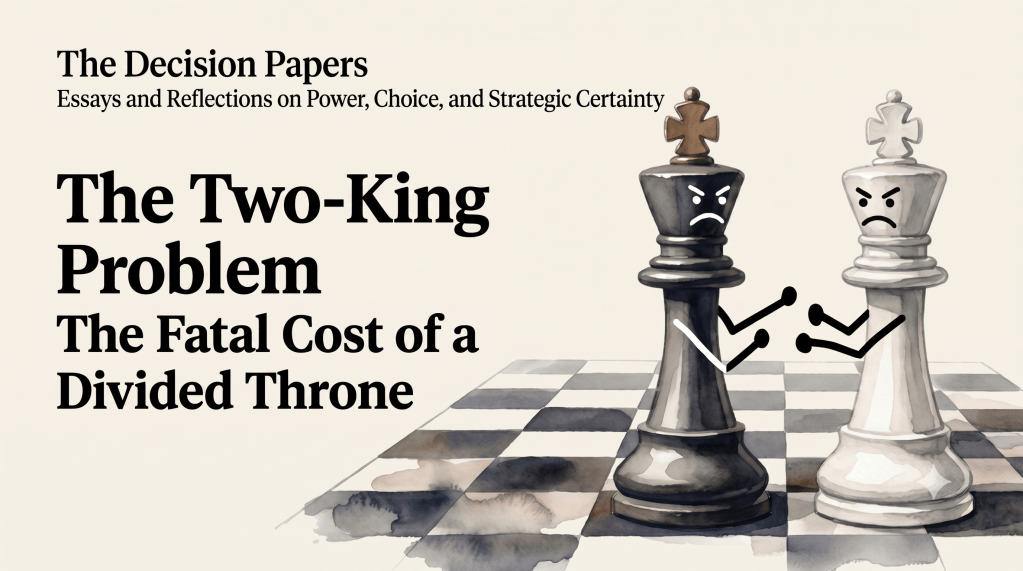
Most organisations know they should not operate without a strategy. Fewer recognise the subtler and more fatal trap: holding two strategies that contradict each other, and refusing to choose between them. Call it the Two-King Problem.
A King is an institution’s tie-breaker. Not a person, but its ultimate, non-negotiable mandate, whose entire purpose is to resolve collisions between competing goods. A valid King names the beneficiary it protects, defines the end in that beneficiary’s terms, declares an order of goods, and sets the cliff edges it will not cross.
Install two such Kings in the same system, each demanding the opposite optimisation, and the organisation does not achieve balance. It achieves a divided throne. And a divided throne is not a richer form of strategy. It is the absence of the one function strategy exists to perform.
The breakdown is mechanical, not cultural. This is the part most leaders miss, because they expect a values problem and get a physics problem instead.
If a King’s job is to resolve a trade-off in seconds, then two beneficiaries and two competing cliff edges destroy that capacity at the root. When the mandates intersect, and under pressure they always intersect, the system has no procedure for deciding which one yields. It stalls.
And the stall does not stay at the top, which is what makes it fatal. Refusing a trade-off at the executive level does not eliminate the trade-off. It delegates it downward, to frontline people who lack the authority to make it.
A product manager cannot design a homepage when the win condition is undefined. A frontline officer cannot prioritise when two mandates each claim precedence. The contradiction the board declined to resolve does not disappear. It is pushed to the precise level of the organisation least equipped to carry it, and there it becomes paralysis dressed as deliberation.
The cost compounds from there. While the divided institution debates itself, competitors optimising cleanly for a single sovereign move faster, decide faster, and pull away.
The damage is not a single bad quarter. It is the slow forfeiture of the capacity to act at all, because every consequential decision now reopens the unresolved question of who the institution is for. An organisation can survive a King it later regrets. It cannot survive having none.
What makes the trap durable is that the divided throne is comfortable at the top. Naming a single sovereign forces a visible loser, a faction whose good is demoted, a leader whose mandate yields, and ambiguity postpones that reckoning indefinitely while looking like breadth. Holding both Kings lets every camp believe its good still governs, so the unresolved contradiction is not an oversight but a peace treaty, purchased at the executive table and paid for downstream. No committee will volunteer the loss, which is why only leadership can end it: the abdication has to be ordered from the one seat that owns the whole board.
The obvious objection is that some institutions are dual-mandate by design, and rightly so. A central bank weighs inflation against employment. A public broadcaster serves both reach and quality. To these, “crown one King” sounds reductive, even reckless.
But a legitimate dual mandate is not two Kings. It is one King with a stated hierarchy, a rule for which good yields when the two collide. The central bank that functions has, written down or understood, what it does when the mandates pull apart. The Two-King Problem is not the presence of two goods. It is the refusal to rank them, so that the collision has no resolver. An institution that can name what yields under pressure has one sovereign. An institution that cannot has none, however much it spends trying to honour both.
The intervention, then, is not a better strategy or a synergy exercise. It is a coronation.
The board must say, in plain terms, that a choice will be made and which good governs when the two meet. Yahoo shows the cost of refusing. For most of a decade it swung between operating as a media business and a technology business, and to the people building the products this was not a difference of emphasis but an impossible brief.
One sovereign served the advertiser, measured in time on site; to honour it, the company built sticky surfaces and kept the user on the page. The other served the end user, measured in speed; to honour it, the company delivered the answer and sent the user on their way. These are not two emphases to balance. They are opposite instructions. You cannot optimise to hold a user captive and to release them quickly at once, and no budget dissolves the contradiction, because the King is not a resource allocator. It is a trade-off resolver. The moment the two mandates meet at a single decision, the money is irrelevant.
An executive team must either prove that one of its two Kings is a subordinate objective flying the flag of a mandate, or force an abdication. There is no structural compromise between two absolutes; the attempt to harmonise them guarantees the institution fails both.
When a system is squeezed between two unyielding mandates, the crisis is rarely one of execution. It is a crisis of identity, and it ends in a room where the team must name the single sovereign out loud.
Name it, and the thousand downstream decisions resolve themselves. Refuse, and the market will eventually name the loser for you.
Two supreme goals are one too many: when both are absolute and they collide, the system loses its tie-breaker exactly when it most needs one.
Decision Rule — The One-Throne Rule
Examine your top two strategic goals.
- The contradiction test. If Goal A succeeded completely, would it require Goal B to fail or be compromised?
- The ten-second test. If forced to cut funding to one of them today, could your leadership agree on which to sacrifice in under ten seconds?
If the team cannot instantly name which goal survives, you have a divided throne. Force one to abdicate, or demote it to a subordinate constraint beneath the other. Compromise between two absolutes is not available.
A system with two tie-breakers has no tie-breaker.


Leave a Reply