“They seem conjoined, but never connected.”
— David Hume
The room thinks it has found the lever. Two lines on the dashboard have moved together for months with uncanny discipline: X rises, Y rises, again and again. Someone says what everyone is already thinking. So if we push down on X, Y comes down with it. Heads nod. The plan forms in real time, budget, owner, timeline, and the room feels competent again, sliding smoothly from pattern to story to action. That smooth slide is the trap closing, because no one has asked the only question that matters: which way does the arrow between X and Y really point?
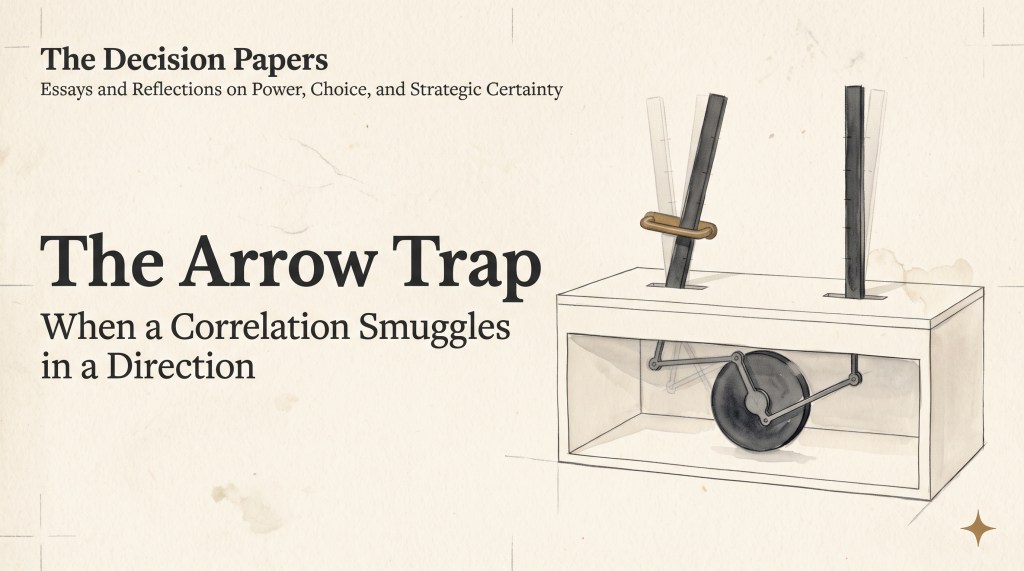
That question exposes the whole illusion. When two things move together, the mind hands us an arrow for free, X drives Y, and it feels like a discovery. It is not. It is a guess wearing the costume of data. A correlation is a shadow, not a mechanism, and the same shadow can be cast by several different worlds. Maybe X drives Y. Maybe Y drives X, and the thing we want to push is the consequence, not the cause. Maybe a hidden third force drives both, and neither one is a lever at all. Maybe the pattern was built by hand, in how the data was chosen. Every one of those worlds draws the identical line on the graph. The arrow the mind grabs is rarely the true one. It is the convenient one, the story that hands us something to pull.
Take the most seductive of these worlds, the one where the arrow simply runs backward. A company sees that teams using its collaboration tool heavily also ship faster, and the arrow draws itself: the tool makes teams fast. So it mandates the tool everywhere, with training and compliance targets. Usage climbs. Speed does not. Because the arrow ran the other way the whole time. The already-fast teams had adopted the tool heavily because they had the slack to absorb it. The speed produced the adoption, not the reverse. The tool was never the engine. It was the exhaust note. Rollouts exactly like this get signed off every year. Usage climbs. The number that matters never moves.
So is the arrow merely backward? Often it is worse than that. Neither X nor Y is driving anything, because a third thing behind both is doing the moving. In that same story, the real driver was probably team capability, which produced the fast delivery and the eager adoption at once. The tool was the signal that a motor already existed, not the motor. And this hidden third hides so well because it is usually the thing no one wants to name, leadership quality, readiness, incentives, since naming it points at an uncomfortable remedy. It is far easier to fund a tool than to fix the management. So the room steers the shadow, because the shadow is the only thing with a handle.
This is why so much confident, chart-backed strategy fails. The intervention works exactly as designed, and the outcome never moves, because the thing pushed was never the cause. Adoption rises, the dashboard glows, and the number that mattered sits perfectly still. Worse, once the correlate becomes a target, people perform it, logging activity to hit the number while the real work stalls, so we do not just miss the cause, we manufacture noise and mistake it for progress. At scale, this is how a proud root-cause analysis becomes a budget, a reorganisation, and a quiet failure filed under implementation challenges, when the fracture was in the arrow from the first slide.
So here is the discipline. A correlation never hands you a lever. It hands you a question. Before we build on the arrow the mind drew for free, we have to make the other worlds argue for their lives.
You might say this is a recipe for paralysis, that if every correlation could be reversed, confounded, or filtered, no one would ever act while competitors move. But the rule is not infinite doubt. It is to match the test to the stake. A cheap, reversible move can ride a single plausible arrow, because if it is wrong we simply stop, and interrogating every small experiment is its own waste. It is the expensive, hard-to-reverse commitment, the company-wide rollout, the restructuring, the bet-the-quarter program, that has to earn its arrow first, because the wrong direction is paid in full and cannot be recalled. Speed on the reversible. Rigour on the irreversible. And there is no need to chase every possible rival, only to name the single most plausible one and rule it out, because a rival left unnamed is a rival left unbeaten.
When the stake is real, three moves earn the arrow. First, draw it both ways on the wall, and give someone standing to argue the reverse, that Y drives X, that your lever is the symptom, so the first convenient story never quietly becomes the only one allowed. Second, force one uncomfortable candidate for the hidden third onto the table, the leadership quality or the readiness no one wants to own, and ask what it would explain that your arrow also explains. Third, and this is the one rooms always skip, ask what your data was never allowed to show you. If you studied only the approved loans, the top performers, the regions that complied, you have built a clean model of a world that does not exist outside your gate, and the pattern was staged by your own filter. Then predict your own failure: if your arrow is wrong, what would you see, and when? A relationship that survives all of this is a finding. One that survives none is a search warrant, not a verdict.
The chart on the wall is real. The lines really do move together. That is exactly what makes the free arrow so easy to believe and so costly to trust. So the next time two lines rise as one and the room reaches for the lever, do not reach with it. Ask which world you are looking at, and make the other worlds speak before you spend a cent. A correlation tells you where to begin the causal work. It never tells you where to end it.
Decision Rule — The Structure Test
Before you treat a correlation as a lever, interrogate the structure that produced it, because the same line can be drawn by several different worlds:
- Draw the arrow both ways. Could Y be driving X? Make someone argue the reverse, that your lever is the symptom, not the cause.
- Name the hidden third. What unmeasured force, capability, readiness, incentives, could be moving both? Force one uncomfortable candidate onto the table.
- Name your filter. What slice did this data come from, and what did it quietly exclude? A pattern built on survivors does not survive the full population.
- Predict your failure. If your arrow is wrong, what would you see, and when? If you cannot say, you hold a hope, not a finding.
- Speed on the reversible, rigour on the irreversible.
A correlation is where the causal work begins, never where it ends.


Leave a Reply