“No man ever steps in the same river twice.”
— Heraclitus
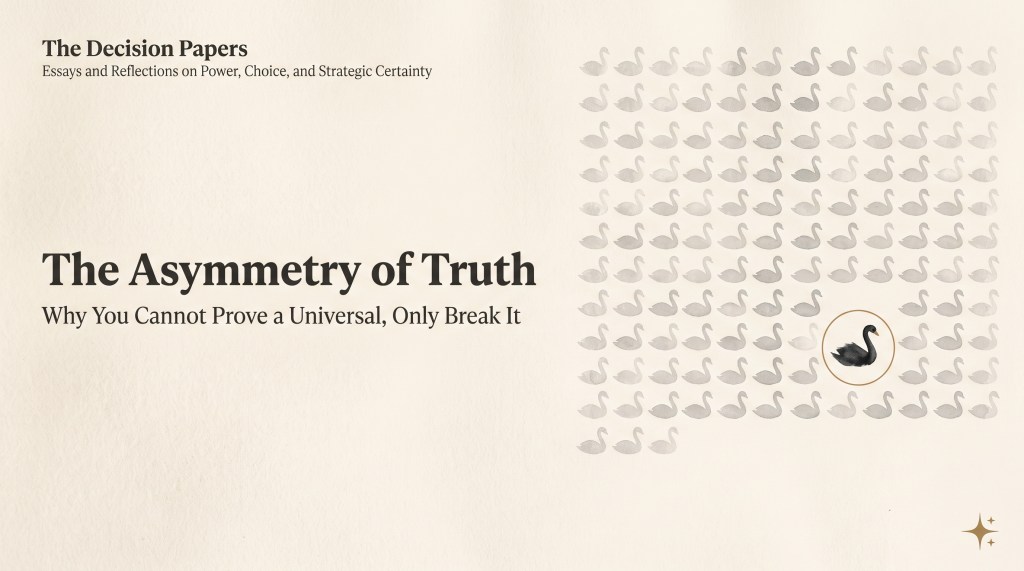
For most of European history, all swans are white was not a theory. It was a fact, confirmed by every swan anyone had ever seen, for centuries. Then, in 1697, a Dutch expedition reached the rivers of Western Australia and watched a black swan glide across the water. One bird undid a thousand years of certainty. And here is the part that should unsettle every leader: no number of white swans could ever have made the rule safe, but a single black one destroyed it in an afternoon.
That is the asymmetry of truth, and most rooms are blind to it. Some claims and all claims behave in completely different ways. To prove some customers want this, you need one customer, and the evidence simply adds up. To prove all of them do, forever, no amount of evidence is ever enough, because the claim is a universal, and a universal cannot be proven, only broken. Confirmation is slow and never finished. Disconfirmation is instant and final. So the question we forget to ask, when a plan is running on a confident all, is which kind of claim we are standing on, and how it could break.
The trap is that we mistake a tall pile of confirmations for proof of a law, and the pile itself is what makes us feel safe. Picture the turkey. Every morning for a thousand days the farmer arrives with food, and every morning confirms the turkey’s theory that the farmer is a friend. Its confidence has never been higher than on the morning of day one thousand, which happens to be the day before Thanksgiving. The turkey did not lack data. It had more data than ever. It mistook a run of history for a law of nature, and the longer the run, the more certain it grew, exactly as its real position collapsed. More data of the same kind is not more truth. It is more history, and a black swan is under no obligation to respect history.
Institutions do this constantly. A ten-year run of growth becomes a new normal. A supply chain that has held becomes secure. And the real damage is not just the false confidence. It is what the word proven does to the people around you. Proven is the most dangerous word in a strategy document. The moment a leader says it is proven that customers want this, the employee who watches a customer walk away is no longer carrying data. They are carrying heresy. So they stay quiet, the early warning is filtered out before it can climb, and the dashboard stays green because the definition of red was quietly recast as disloyalty. Like the turkey, the institution feels safest at the exact moment it is most exposed, because the long run of good news has switched off the one question that could have saved it.
So what do we do, if we can never prove the thing our whole strategy depends on? You stop trying to prove it, and start trying to break it. You hold the claim at the confidence reality has earned it, and you name, out loud and in advance, the one thing that would tell you it has finally met its black swan.
You might say this is a recipe for never committing. If any universal can be broken, and a black swan can always be imagined, does a leader just hedge forever? No, and the difference is everything. Refusing to commit is not the rule. Holding the claim at its earned confidence is. There is a real gap between a claim that has survived years of people trying hard to break it and a claim that has merely collected agreement, and the first has earned the right to be committed to and scaled. The discipline does not kill conviction. It attaches a tripwire to it, so that we can commit hard and stay watchful at once, instead of choosing one. We act on the best-tested universal we have. We keep one eye on the thing that would end it.
In the room, this is one concrete habit. Before a settled truth is allowed to steer real resources, ask a single question of it: if this were wrong, what is the first thing we would see? Not a vague if it goes badly, but a specific, early signal, a named rise in churn, a shift in what the regulators are saying, a competitor’s move you had ruled out. Write that signal down before you commit. That one act changes everything downstream, because it turns the black swan from a catastrophe that ambushes you into a data point the organisation now has open permission to notice, name, and report. A truth that has not survived that question is really a hypothesis, and it should travel with low confidence and close watching. Only one that has is a theory, and only a theory has earned the right to scale.
The black swan was always out there, gliding on some river no European had sailed to yet. Your strategy has one too. You will never prove it is not coming. But you can decide, today, what its arrival would look like, and give everyone around you permission to shout the moment they see a single dark feather. Prove nothing forever. Name exactly where it breaks, and watch that spot.
Decision Rule — The Provisional Rule
- You cannot prove a universal, only fail to break it, so hold every load-bearing claim at the confidence reality has earned.
- The status. Has this claim survived people trying hard to break it (a theory, commitment-grade), or has it only piled up agreement (a hypothesis, watch it)?
- The black-swan clause. Name the first specific signal you would see if the claim were wrong, and the date you will check for it.
- The exposure test. Is your confidence rising because the claim is stronger, or only because the run of good news is longer?
- A universal you cannot say how to break is one you have not earned the right to call proven.
Hold the claim at earned confidence, and name in advance the one thing that would end it.


Leave a Reply