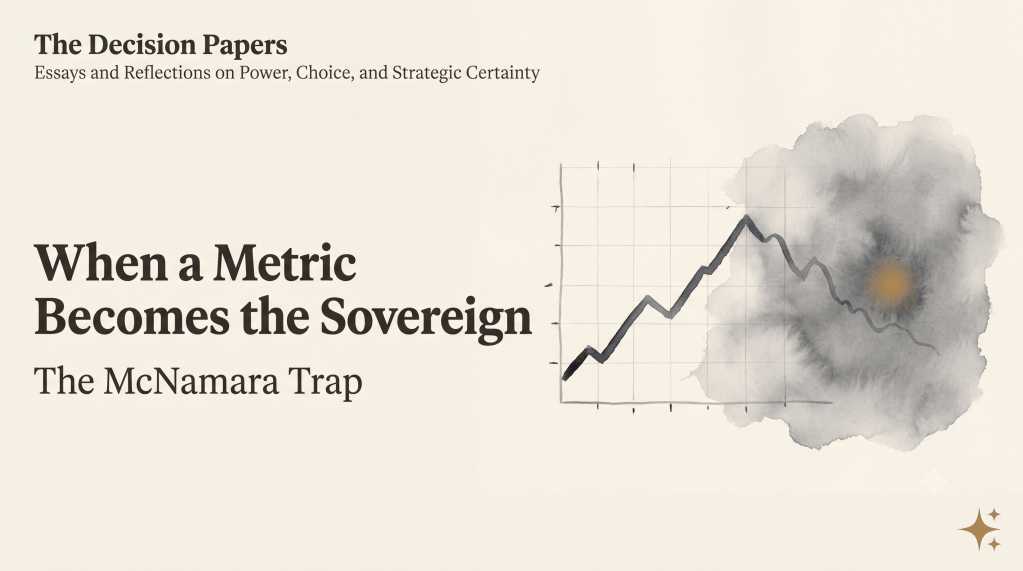
“A witty statesman said you might prove anything by figures.”
— Thomas Carlyle
Robert McNamara came to public decision-making with an ambition you should admire: to make enormous choices more disciplined by separating what leaders wished from what the evidence showed. His whole reputation was built on measurement, the rigour that let modern organisations scale past personality and instinct. In Vietnam, he tried the same move, turning an unbounded war into something legible enough to govern. The ambition was not foolish. It was a bet that measurement reduces self-deception. The bet failed, and it failed in a way worth studying. It failed on the question the room never asked, and the one you have to ask in every room like it: can the thing you choose to count carry the weight you are about to place on it?
The metric that rose to the throne was the body count. Countable. Reportable. Easy to graph into the shape of progress. And that choice quietly moved a boundary most rooms never notice. A metric can testify, or it can rule, and these are two different offices. A witness reports what it saw under specific conditions. A sovereign decides what the institution will treat as true and act on. The body count was a legitimate witness to attrition. It was crowned sovereign over the war. And what changes when a witness takes the throne? Everything it cannot see stops counting.
Do not confuse this with a data-quality problem, because the numbers were not necessarily wrong. The failure was not bad counting. It was a witness on the throne. A measure that could speak about one dimension of the conflict was allowed to rule on dimensions it could not see. The danger is never bad data. It is accurate data ruling outside its competence.
The trap works as a chain of small, reasonable substitutions, each defensible on its own. A war is more than an inventory problem. It is also a problem of political will, of national identity, of the meaning a people assign to their own sacrifice. The body count could measure losses. It could say nothing about resolve. But resolve is hard to count and losses are easy, so the easy measure stood in for the hard reality.
Then the measure became the scoreboard, and the scoreboard rewrote the question. The room stopped asking are we winning the political war and started asking are the numbers improving. Those two questions sound adjacent. They are entirely different. And once the second replaced the first, every honest answer to it pointed away from the truth.
The reasoning around the metric stayed coherent, which made it more dangerous. If enemy losses exceed replenishment, the logic ran, the war converges toward victory. The inference was clean. Its premise, that the opponent’s will behaved like a balance sheet, was false. A flawless chain of logic resting on a false premise produces confident, well-documented error, and it feels like rigour the whole way down.
The cost compounds, because the system suppressed its own corrections. Front-line pattern sense, the seasoned feel that something was wrong, could not compete in the currency of charts, so it was discounted, or it went quiet. In a culture where only the countable counts, the warning that cannot be quantified never gets heard, and the institution loses the ability to learn before the catastrophe instead of after.
Feedback itself was the last casualty. In complex environments, as Errol Morris’s portrait of McNamara showed, feedback arrives late and distorted, bent by politics on the way up. It is not simply what happened. It is what can be observed, transmitted upward, and survive the pressure of the narrative. And when feedback is fogged, the institution reaches for the most seductive substitute there is: a clean metric that manufactures the feeling of control at the exact moment control is slipping.
The obvious reading is that measurement failed, and the lesson is to trust judgment over data. That reading is wrong, and dangerously so. This is not a story against measurement. McNamara’s instinct, to discipline decisions with evidence instead of charisma, was right, and the alternative, governing by unexamined intuition, fails more often and more quietly. The failure was not that the room measured. It was that it let one measurement rule outside its competence, and punished every signal that did not fit the chart. The answer is not less data. It is data kept in its proper office: consulted as a witness, cross-examined like one, and never seated as judge. A room that abandons its metrics is as ungoverned as a room that worships them.
So how do you keep a witness from becoming a sovereign? You cross-examine it. Interrogate a metric before you let it become a scoreboard, the way a court interrogates a witness before it relies on the testimony. First, establish what the metric testifies to, as opposed to what you are pretending it testifies to. The body count testified to attrition. The room treated it as testimony about victory. Name that gap out loud. Second, surface the premise the metric depends on, the assumption that has to be true for the number to matter, and ask whether anyone has tested it. The attrition logic needed the enemy’s will to behave like arithmetic, and no one priced that premise. Third, name the cost the metric is blinding you to, the dimension it cannot see, legitimacy, dignity, resolve, so that what cannot be counted at least stays on the table. Fourth, ask what the people closest to the ground are sensing that the chart does not show, and give that signal a way to survive without disguising itself as data.
In room after room, the number on the slide quietly becomes the thing everyone is serving, and the one person who feels the ground shifting cannot say so in the only language the room still respects. So before you let a number become the scoreboard, put it on the stand and ask what it is qualified to say. Measure relentlessly. But keep the measure in the witness box, and never let it take the throne.
Decision Rule — The Witness Audit
- Before treating any metric as a scoreboard, cross-examine it as you would a witness.
- Testimony. What does this metric testify to, as distinct from what we are pretending it proves?
- Premise. What must be true about the world for this number to matter, and have we tested it?
- Blind spot. What cost or dimension, legitimacy, dignity, resolve, does this metric not capture?
- The frontline. What are the people closest to the ground sensing that this chart cannot show?
- If a metric cannot survive this interrogation, it may inform the decision. It may not rule it.
Put the number on the stand before you let it take the throne.


Leave a Reply