“Experience never errs; it is only your judgments that err by promising themselves effects such as are not caused by your experiments.”
— Leonardo da Vinci
Two smart people are arguing, and neither can move the other an inch. One keeps saying the logic is airtight. The other keeps saying show me the data. Both are certain they are the reasonable one in the room. Both are right. And they will argue past each other until the meeting dies, because they have missed the one thing that would end it: they are not paying in the same currency. You have sat in that argument. You may have been one of the two.
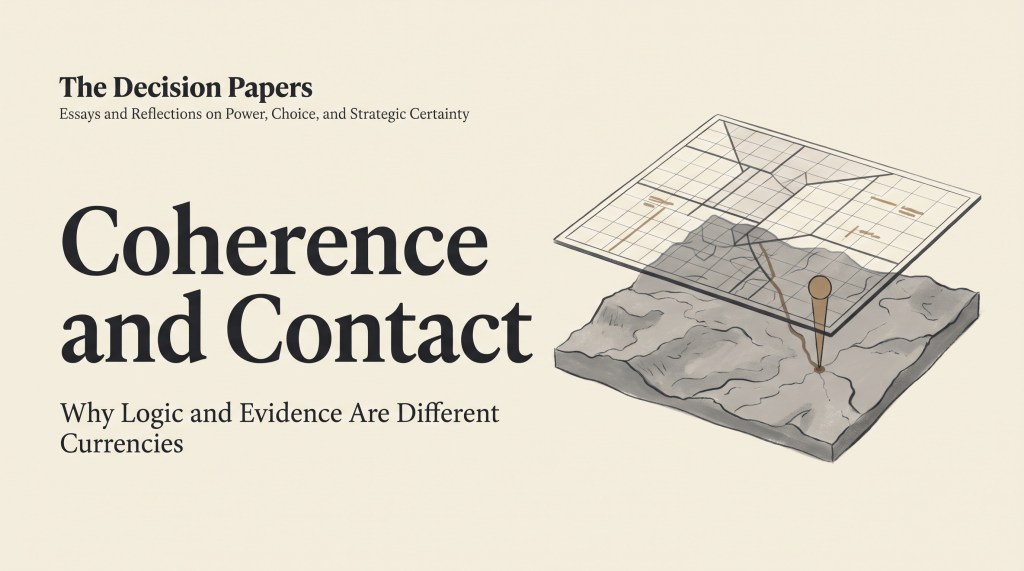
Here is what the room keeps missing. Logic and evidence are not two flavours of the same truth. They are two different currencies, and neither can buy what the other sells. Logic is the discipline of consistency. It asks whether an argument contradicts itself, breaks its own rules, or smuggles in a conclusion it never earned, and it can clear vast territories of nonsense in an afternoon. What it cannot do is confirm that the world agrees. A perfectly coherent map can describe a country that does not exist. Evidence is the other currency, the one thing that buys contact with reality, the observation that separates one explanation from every rival that would fit the same story. Hold these apart, because confusing them is the whole failure. Coherence is not evidence. Measurement is not meaning. An argument that hangs together has earned the right to be considered, not the right to be believed, and the gap between those two is where clever rooms fall.
The confusion runs in both directions, and we have to learn to hear each. The first is spending coherence as if it were evidence: it must be true, look how consistent it is. A beautiful argument feels like proof, and the more airtight it is, the harder it becomes to force in the step where reality is allowed to disagree. The second is the mirror image: spending measurement as if it were understanding. We tracked it, so we must know what drives it. But a number tells us that something happened. It never tells us why, and a room that mistakes the metric for the mechanism will pull a lever wired to nothing. Both are category errors. Both are invisible from the inside, because each one feels exactly like rigour. The logical arguer is sure they are being logical. The measuring arguer is sure they are being empirical. Each is right about what they are doing, and wrong about what it buys.
The result is the most expensive thing an institution can be: not uncertain, but confidently wrong. Spend coherence as proof, and we commit the whole organisation to a model that was never tested against the world, and we find the gap only when reality declines to play along. The most dangerous plan is not the sloppy one. It is the elegant one no one ever checked against the world. Science is littered with the wreckage. The luminiferous aether was a serious, respectable theory of how light travels, internally consistent, defended by careful people, and completely wrong, because the world’s signature never matched it. Coherence bought it decades. Contact eventually killed it. An institution that cannot tell the two currencies apart will go on funding its own aethers, elegant and doomed, until the evidence finally arrives, too late and too dear.
This can sound like a demand for proof before you are allowed to move, and most real decisions cannot wait for a clean signal. That objection is right, and it matters. The startup, the new policy, the first-of-its-kind bet all have to run on coherent reasoning long before any measurement can speak, and a leader who refuses to move without evidence there is not rigorous. He is paralysed. But knowing your currency was never the same as waiting for proof. Gravitational waves were sound reasoning for a century before any instrument could register one, and the theory was right the whole time it went unconfirmed. You are allowed to act on coherence when evidence cannot yet testify. You are just not allowed to let it pose as something it is not. Label the bet as a bet, a structured argument not yet confirmed, and you can hedge it, stage it, and watch it. Call the same bet a certainty, and you can do none of those things. The discipline is honesty about the currency, not a ban on spending it.
So put every claim to a simple test before the room leans on it. Which currency is this paid in? When someone brings a logical claim, ask for the constraints. What does the model assume, what does it forbid, and what does it predict if it is true? A model that forbids nothing explains nothing. When someone brings an empirical claim, ask for the discriminating signature: what single observation, if it came out the other way, would force us to downgrade this explanation against its rivals? In most organisations that signature is a leading indicator, the number that, if it turns, tells you to pivot. And if a speaker can give you neither the constraints nor the signature, you are not looking at knowledge. You are looking at authority, narrative, or momentum in a lab coat.
So before you accept the next confident claim, stop and ask what it is paid in. Then refuse to let it buy what that currency cannot. Logic earns a claim the right to propose. Only evidence earns it the right to say this fits the world. The wisdom is in knowing which one you are holding, and never spending it outside its borders.
Decision Rule — The Currency Rule
Before accepting any consequential claim, require it to declare which currency it is paid in:
- Name the currency. Is this coherence (a logical or modelled argument) or contact (an empirical observation)?
- If coherence: what does the model assume, what does it forbid, and what does it predict if true?
- If contact: what observation, coming out the other way, would materially downgrade this claim against its alternatives?
- You may act on coherence before evidence can speak, but label the bet as a bet, never as a fact.
A claim that can state neither constraints nor a discriminating signature is not knowledge yet. It is authority in a lab coat.


Leave a Reply