“It is far better to foresee even without certainty than not to foresee at all.”
— Henri Poincaré
Two companies get the same warning from the same kind of model: a sharp drop in demand is coming, six months out, and the forecast is solid. In the first boardroom, the question is how do we stop it? They pour money into campaigns and discounts, straining to hold demand where it was. In the second, the question is different. Given this is coming, what do we do? They trim the cost base early, lock in a credit line while money is still cheap, and quietly prepare to take share from rivals who will panic. Six months later the slump arrives, exactly as predicted, for both of them. One firm is bleeding from a fight it could never win. The other is positioned to win. Same model. Same forecast. Opposite fate. The difference was a single question asked at the very start, and almost no one asks it.
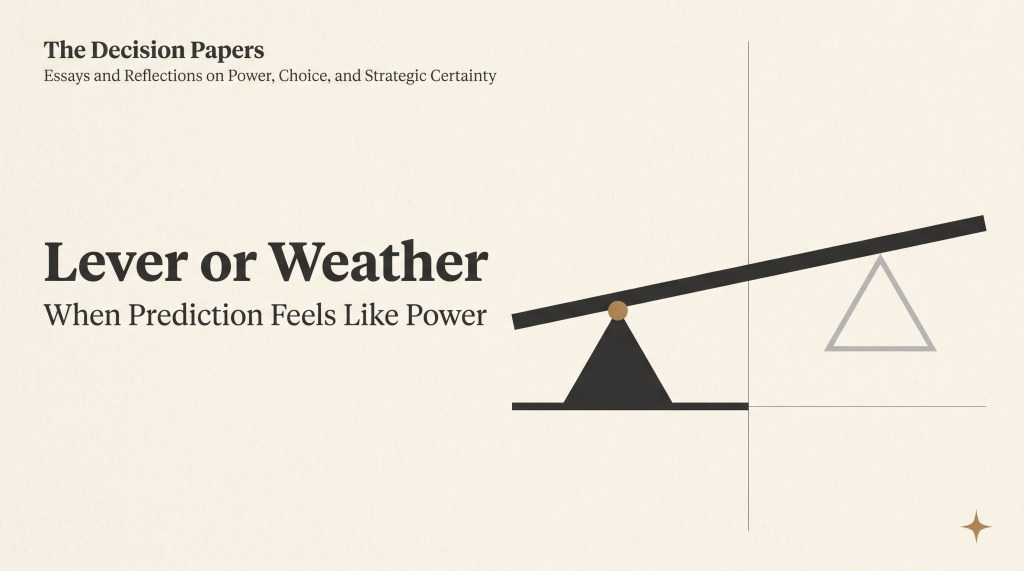
That question is the whole essay, and it is deceptively simple. When a model tells you what is driving an outcome, you are always in one of two situations, and they demand opposite responses. In the first, the drivers are yours to move. Onboarding drives churn, pricing drives margin, staffing drives the wait times, and every one of those sits inside the business. These are levers. Reach out, pull, and the outcome changes. In the second, the drivers are real but they belong to someone else. A recession drives sales, a rate rise drives the cost of borrowing, a rival’s launch drives away traffic. The model is right about the cause, and you still cannot touch it. Here the model is not a control panel. It is a weather forecast, and no one argues with the weather. You decide what to do because of it. Call it the first question of any model: are these drivers mine to pull, or forces I have to take as given?
The reason this matters is that the two situations call for opposite work, and the effort that wins one is wasted in the other. In the first, you spend everything on the drivers themselves, because moving them moves the world. In the second, pushing on the drivers is pushing on a wall. The recession will not shrink because a company wants it to. So the work moves onto the response instead, and the winning move becomes to seize the opening the forecast reveals, to cut the exposure before it bites, or to hedge the risk that cannot be removed. The most disciplined operators are not the ones with the most levers. They are the ones who can say, without flinching, this force is not ours, and plan around it.
Here is the twist that fools clever rooms: the same force can be a lever in one seat and a given in another. An interest rate is a lever for the central bank that sets it and a given for the shop that pays it. Position, not the variable, decides which situation you are in. So the room that treats every driver as a lever, because that feels like leadership, keeps shoving at the very forces it should be planning around.
Get the classification wrong and it fails in one of two directions. Mistake a given for a lever, and the company burns budget and morale fighting a force that was never going to move, campaigns against a recession, willpower against a market, exhausting itself on the one front where effort cannot land. This is the common error, because it feels active and brave. Mistake a lever for a given, and the mistake is quieter. The room shrugs at something it could have changed, files its own onboarding or its own pricing under forces beyond our control, and sits still while the fixable slowly drains it. One error wastes strength. The other wastes the chance. Both come from skipping the single question at the start.
So before acting on any model, do the classification first. Take each driver it names and drop it into one of three piles: this one is yours to pull, this one you must take as given, and this one you can bend a little but not break. That sorting is the decision that quietly decides all the others.
Two charges land here: that this is obvious, and that the second situation is a soft word for giving up. Neither is true. It is not obvious, because rooms misclassify all the time, dressing a given as a lever to look decisive. And the second situation is the opposite of surrender. Naming a force as given is not lying down before it. It is turning to face it and choosing a move: positioning for the opening it creates, cutting the cost before it lands, buying the hedge while it is still cheap. The captain who cannot calm the storm is not helpless. He is the one who reads it and sets the sails.
In the room, the move is concrete. Put the model’s drivers on the wall and split them into two columns, ours and given. For every driver in the ours column, design the intervention: what to pull, and how to know it moved. For every driver in the given column, design the response instead: the opening to position for, the cost to cut early, the risk to hedge. Then set a date to revisit, because control is not fixed. A force that is given today can become a lever tomorrow, once you gain the scale, the partnership, or the standing that finally lets you reach it. The room that keeps these two columns honest spends its energy where energy can land.
The weak room asks one question of every problem: how do we change this? The strong room asks an earlier one: is this ours to change at all? The point was never to control everything. It was to know, before you spend a single day of effort, which game you are playing, the one where you move the cause, or the one where you move around it. Get that right, and even a forecast you cannot fight becomes something you can use.
Decision Rule — The Two-Situations Test
Before acting on any model, classify what it shows before deciding what to do about it:
- Sort the drivers. For each cause the model names, mark it yours to pull, a given you must take as it comes, or partly yours.
- On the levers, intervene. Where a driver is yours, design the move that changes it, and how you will know it worked.
- On the givens, respond. Where a driver is not yours, stop pushing and position instead: seize the opening, cut the exposure, hedge the risk.
- Check your seat, not just the variable. The same force can be a lever for one player and a given for another; your position decides which.
- A given today can become a lever tomorrow, so revisit.
Ask first whether a driver is yours to change, then how.


Leave a Reply