“Nothing is easier than self-deceit. For what each man wishes, that he also believes to be true.”
— Demosthenes
You have sat in some version of this room, facing a decision big enough to outlive the people making it. Finance opens: the data is clear, a twenty percent efficiency gain; Operations answers that it is not ready, and a public failure would cost trust it cannot rebuild. Someone asks whether the technology should serve people or erase them. Counsel cuts in: it breaks the privacy statute. Then the room closes itself. You know what the boss expects.
Freeze that scene and it looks ordinary: numbers, risk, law, values, politics. But listen again. Everyone used the same word, rational, and everyone meant something different by it. The question no one asks decides everything. Which kind of reason is allowed to win?
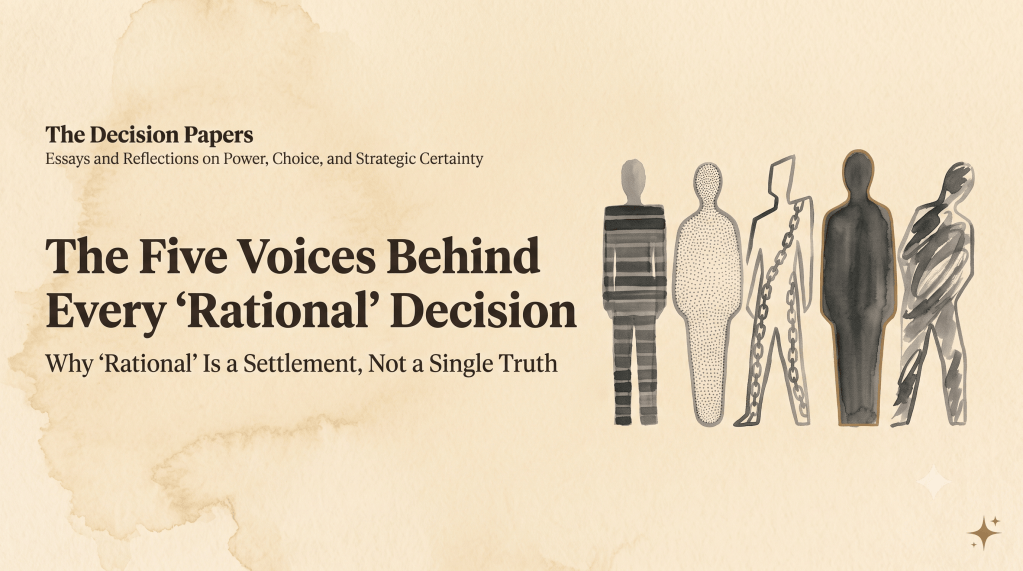
The room is not governed by a single rational voice, but by a settlement among five ways of knowing. We obsess over process, as if the right answer falls out at the end. Long before the dashboard lights up, a quieter choice was made: what do we let count as truth here?
Do not confuse this with good decisions are simply logical. Logic is one of the five voices, not the container that holds them. The five are authority, empiricism, logic, values and beliefs, and intuition. Leave their settlement ungoverned and the room turns lawless, where the most persuasive voice wins whether or not it is right.
Each voice is indispensable, and each fails in its own way.
Authority is outsourced truth, trusting work you cannot re-run. You do not re-derive germ theory before you wash your hands. Its failure is deference dressed as truth, when because they said so ends thought and dissent becomes disloyalty. Authority is permission to proceed, not proof reality agrees.
Empiricism is observed truth, contact with the world, the only voice that must risk being wrong to improve. Its failure is measurement theatre, when the measurable replaces the meaningful and the room stops asking is this true and asks is this reportable. Data is a witness, not a ruler.
Logic is consistent truth: it turns vague claims into stated premises and makes reasoning inspectable, so no board is held hostage by charisma or volume. Its failure is mistaking premises for reality, because a clean chain feels like certainty even when every input was a guess.
Values and beliefs are legitimacy: the goods that outrank other goods, the lines an institution will not cross whatever the numbers say. Its failure is the sacred premise disguised as a fact, when it is just not scalable is a moral veto in technical clothing. A value can veto an option. It cannot prove one.
Intuition is compressed judgment: years of feedback collapsing into this deal smells wrong before any model can say why, a separate speed built to spot the anomaly under complexity. Its failure is the verdict with no reasons, bias dressed as experience, fear mistaken for wisdom. Intuition is a hypothesis generator, not a higher truth.
The danger is not that these voices exist. It is that they lie about what they are, and the lying comes in three kinds. Voice fraud: one way of knowing borrowing another’s uniform. Intuition calls itself the data. A moral veto poses as an argument about scale. A title gets treated as a fact. Value fraud: an interest impersonating a value, the budget defended as the mission. Belief fraud: an inherited conviction impersonating a finding, faith in the tone of something tested. All three work because rooms reward persuasion even when they do not reward truth, and when a fraud wins the room stops negotiating truth and negotiates obedience. It believes it explored reality. It performed alignment.
The cost compounds. The efficient monster is born when logic runs without values and beliefs, technically flawless and morally void; the emperor’s cliff arrives when authority overrules the evidence: the chart says danger, the leader says march, and the silence that follows is self-protection, not agreement. Neither looks like irrationality from the inside. Each looks like rigour, until the consequences arrive.
Five voices and a fraud check sound like paralysis by committee. But this is a reflex, not a committee. Naming a voice does not slow the decision. It strips the disguise, which was slowing things all along. A room that cannot tell a hunch from a measurement argues in circles. One that can resolves it fast.
The move is to govern which voice may rule on what, in three parts.
First, tag the voice in real time. When someone tells you the rational answer is obvious, do not argue the conclusion, ask what kind of claim it is: data, precedent, or values and beliefs. When it is values and beliefs, go one layer down: name the value served, and name the belief taken on faith. Named, a voice loses the power to impersonate another, which is where fraud lives and dies.
Second, make the veto power explicit. In safety and engineering, empiricism stops the train: if the critical test fails, the launch does not happen; in rights and dignity, values and beliefs hold the veto, and no spreadsheet outvotes a declared non-negotiable. Intuition can carry the ambiguous human calls, but only named as intuition, a hypothesis that must earn the right to scale. Authority can set constraints, but it should not end inquiry on its own.
Third, run the goalpost test when the argument turns suspiciously fluent. Ask: if the evidence had pointed the other way, would we argue with the same confidence? If not, the room is not following the evidence. It is recruiting it, and some desire or fear has already put on another voice’s uniform.
A single I just don’t think this is right can end an argument a hundred slides could not, and the same hunch, named as a hunch, can turn out debatable, then wrong. So when a room calls something rational, do not take it as one thing. Ask which voice is leading, and whether it is speaking as itself or in costume, a discipline that now stretches to machine claims arriving sounding like evidence while carrying no provenance of their own. Govern which voice may rule on what, and the decision becomes legible, contestable, and at last yours. Leave it ungoverned, and you are not deciding. You are obeying whichever voice argued best.
Decision Rule — The Five-Voice Card
- When a room declares an answer rational, audit the reasoning before you accept the closure.
- Name the voice. Is this claim speaking as authority, empiricism, logic, values and beliefs, or intuition? If it speaks as values and beliefs, name the value and name the belief.
- Check the fraud. Voice fraud: is one way of knowing borrowing another’s uniform, a hunch posing as data, a title posing as a fact? Value fraud: is an interest speaking as a value? Belief fraud: is faith speaking as a finding?
- Run the goalpost test. If the evidence pointed the other way, would we argue with the same confidence? If not, the room is recruiting evidence, not following it.
- If you cannot name which voice is leading, you are not deciding. You are obeying.
Make each reason declare which voice it speaks as before you let it close the room.


Leave a Reply