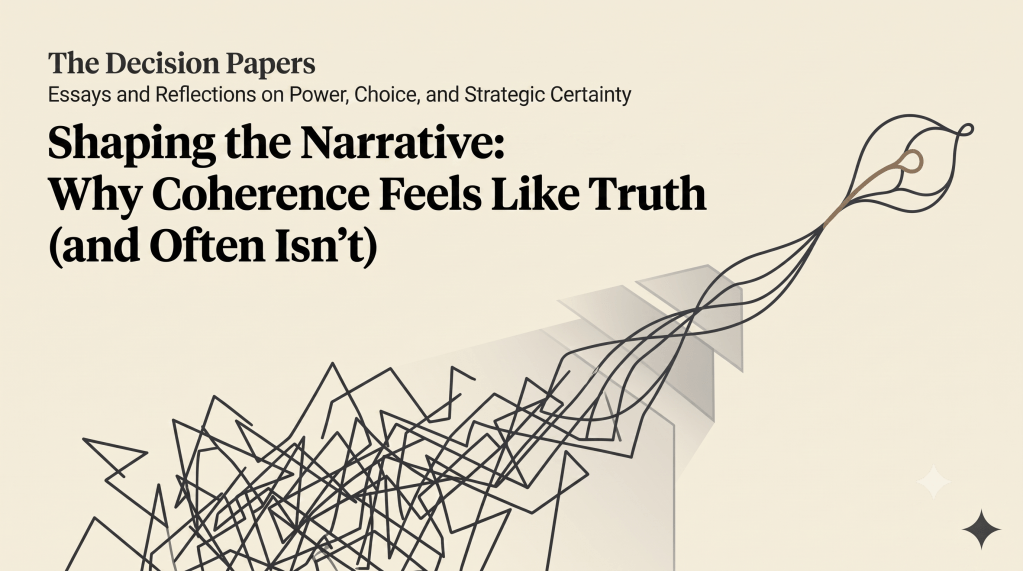
“For every complex problem there is an answer that is clear, simple, and wrong.”
— H.L. Mencken
A signal claiming the institution’s attention produces two pressures, and leaders rarely acknowledge the second.
The first pressure is to explain what is happening. The second is to explain it in a form the room can live with, a story that travels upward, survives meetings, aligns stakeholders, and restores the feeling of control. In practice, the room does not merely investigate the situation. It shapes the account of it.
The question no one asks, as the briefing takes shape, is whether the smoothness of the story is evidence of clarity or of editing.
Name it: the coherence trap, the move by which a story wins acceptance not because it has earned contact with reality but because it has become socially manageable.
A coherent story is not necessarily false, but coherence is an internal property: the parts fit, the language is clean, the contradictions are quietly removed, and the room feels calmer. None of that proves the story met reality. It only proves the story was made transmissible, which the institution is structurally inclined to reward.
Seal this off from a related but different failure. A story winning because it arrived first, before the alternatives could surface, is a separate phenomenon with its own discipline: it operates by temporal lock and political gravity. This failure operates by social selection. A story can arrive third in the conversation and still win, because it is the smoothest of the three, the one that briefs cleanest, the one that produces the action plan the room can endorse without embarrassment. Coherence and primacy are two distinct routes by which an untested narrative captures an institution.
The mechanism is that smoothness does institutional work that jaggedness cannot, and the work is rewarded faster than truth is.
In a flat room of peers, smoothness operates as ego protection. A committee reviewing a failing launch faces a jagged truth, that the product may have a weak core loop, and that truth threatens the team that built it, the leaders who backed it, and the room’s sense of competence. A smoother story appears by gravity: the product is strong, the market does not yet understand it, this is a messaging problem. It is accepted not because it beat reality but because it beat embarrassment, and it yields a respectable action plan that lets the room continue.
In a hierarchy, smoothness operates as vertical stability. As signals rise, jagged truth is edited at every layer into executive-safe language: contradictions become friction, delays become phasing, incompatibilities become integration complexity. Two enterprises merging under board promises of synergy may carry chaos below, systems that do not match, failing handoffs, key people threatening to leave, while the board receives a coherent milestone update, because each layer removed the jaggedness before passing it up. What reaches the top no longer describes the terrain; it describes what the terrain had to become to survive the meeting.
The cost is that briefability quietly becomes a truth filter, and the institution stops being able to tell the difference.
A story that is easy to summarise begins to outrank one that is hard to transmit. A clean deck feels more serious than a conflicted one; here is the plan sounds more leader-like than here are the unresolved contradictions. The organisation learns the lesson it was never taught: rough truth is career-risky, coherent confidence is promotable, and the room rewards whoever removes friction fastest.
This is the watermelon effect: green on top, red underneath, and a leadership team that learns the real situation only when the red breaks through. The signal was not absent; it was edited at every layer between the edge and the executive room, and what arrived was a managed appearance of certainty. At scale, the organisation runs for years on a confident strategic picture that exists in no operational reality.
The objection is real and must be answered: if every smooth narrative is suspect, the institution cannot function, since meetings, decks, and reports exist precisely to compress reality into transmissible form, and a leadership that demands jaggedness on every briefing will drown in operational noise it cannot act on.
The objection holds against the wrong reading. Compression is not the failure; smoothing is. A briefing can abstract reality at the right altitude, naming what it simplified and where the simplification might fail; or it can smooth reality into something materially different and present that as the picture, which is editing dressed as reporting. The discipline is not to demand jagged briefings. It is to demand briefings that name their own compression, honest when they name their losses, dishonest when they conceal them.
In practice, the move is to protect roughness as an admissible feature of reality at every layer of the briefing chain, so the story cannot purchase coherence by suppression.
A leadership system under this discipline allows three things smooth narratives remove. It allows uncertainty, so incomplete knowledge survives upward travel without being edited into false confidence. It allows disagreement, so unresolved contradiction is treated as signal, and the operational layer’s dissent need not be paid for in career terms to reach the board. And it allows incompleteness, so partial truth told quickly outranks a complete fiction told later.
When a briefing contains none of these, the room should not reward it with confidence; it should raise the burden of proof and ask, without euphemism: what had to be removed to make this travel? Who disagreed, and where did their disagreement go? What part is in contact with reality, and what part is managerial smoothing? A briefing that cannot answer is not a report but a managed appearance, and acting on it commits the institution to a picture that exists only in the room.
So before you accept the cleanest version of the story, look at the seams where the jaggedness was removed and ask what they were holding.
Protect roughness as a feature of reality. If you demand a perfect slide, you will get a perfect lie.
Coherence is the cheapest thing to manufacture and the easiest to mistake for truth; a story smooth enough to feel settled has often been managed on the way up.
Decision Rule — The Provenance Card
When a briefing is too clean, do not trust it more. Test it harder, by asking three questions in plain words.
- The smoothness test. What had to be removed to make this story travel, and is the removal acknowledged anywhere in the briefing?
- The dissent query. Who disagreed with this synthesis, and where did their disagreement go between the operational layer and this room?
- The contact test. What part of this account is in direct observation from the edge, and what part is managerial smoothing on the way up?
A story that cannot survive contradiction, name its own compression, or locate its evidence has no right to close the room.
A briefing that cannot name what it left out is not a report, it is a managed appearance, and the institution that acts on it commits to a picture that exists only in the room.


Leave a Reply