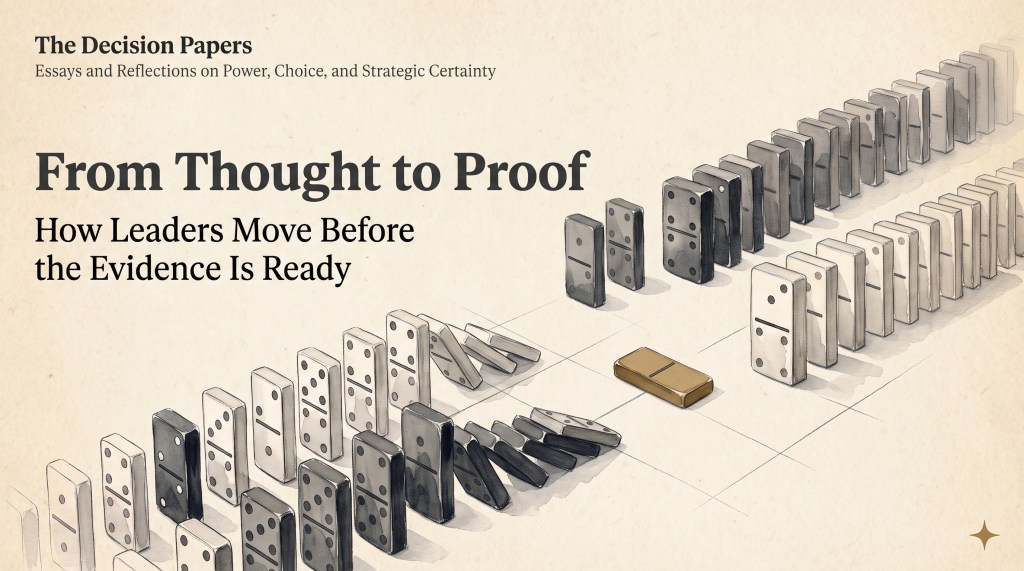
“Hypotheses are nets: only he who casts will catch.”
— Novalis
In 1854, a London doctor asked a parish council to do something that sounded like superstition: take the handle off the Broad Street water pump. Cholera was killing the neighbourhood, and everyone knew it came from bad air. Germ theory was unproven. The bacterium behind cholera would not be found for thirty more years. So by the standard of settled science, John Snow had nothing. No mechanism. No microbe. No proof. What he had was a map, a pattern, and one idea worth more than certainty: a move small enough that reality could answer it. They pulled the handle. The cases fell.
Snow had solved the problem every leader eventually faces. We have to act, and the evidence is not in yet. Wait for certainty, and people are hurt while we gather it; move without it, and we may be scaling a mistake. The way through is to see that the word evidence hides two very different things, and to stop treating them as one. One is thought: a belief we have reasoned our way to, a coherent model, a pattern that fits, an argument that holds. The other is proof: a belief reality has confirmed by pushing back and agreeing, not mathematical certainty, but enough real-world validation to bet the institution on. Thought is what we can build in our heads. Proof is what the world has signed off on. Snow had the first and knew he lacked the second, and that knowing is the whole discipline. Call it the working draft: acting before certainty without pretending we have it.
The difference matters because thought and proof are two currencies, and each can only buy certain things. Thought buys a test. A good model earns the right to try one thing, once, in a small and undoable way, to see if the world agrees, and it justifies the pilot, never the rollout. Proof buys the commitment. Only after reality has confirmed the idea do we get to scale it, standardise it, and build it into how the institution runs, and only then have we earned the move we cannot take back. The whole skill is keeping the two apart. Spend thought on the test. Spend proof on the commitment. Never the other way around.
Break that rule, and the failure runs in one of two directions. Overpay, and a clever model gets treated as a proven fact and scaled as though reality had already agreed, when it has not, so the mistake ships everywhere at once, carrying the full authority of evidence it never earned, and by the time the world disagrees the cost is already spent, in a hundred places, on people who never saw the bet being placed. Underpay, and the room freezes. There is no evidence for this, someone says, and refuses to move, mistaking the absence of proof for proof of absence. But most things are untested not because they are false, only because no one has run the test yet. One failure scales a guess. The other buries a good idea. Both come from the same confusion: treating thought and proof as one thing.
So how do you act before the proof is in, without gambling the institution on a hunch? You do what Snow did. You make the bet small enough, and reversible enough, that reality can answer it before it can hurt you. A pulled pump handle costs little and goes back on within the hour, so if the cases keep climbing, you were wrong, and you have lost a week, not a city.
You might object that this is exactly what every quack says too. Give me a chance to test my theory on real people. And the worry is fair, because the words are identical. The difference is not in the words; it is in whether the bet can be unmade. A real test is small, short, and built with a way to stop, so where the downside can be walked back, a promising idea has earned the right to a try. But where it cannot, where the harm is to lives, or the move can never be reversed, no evidence stops being a reason to experiment and becomes a warning label. The quack wants to run the irreversible test on us. The disciplined leader runs the reversible one, and lets reality rule.
In the room, this comes down to two habits. First, stop calling everything a fact. Before a claim is allowed to drive a decision, name what it has earned. Is it a hypothesis, a hunch we are exploring, which buys a test and nothing more? A model, a reasoned structure with some support, which buys a reversible bet? Or a fact, confirmed and repeatable here, which has earned the right to be scaled? Most disasters begin when a hypothesis is waved through the room dressed as a fact.
Second, before you act, say out loud what would make you stop. Name the result that would prove you wrong, and the point at which you would pull the handle back. Snow’s was silent but real: if the cases had not fallen, the handle went back on and he looked elsewhere. Say it in advance, and reality stays in the loop; leave it unsaid, and you will explain away every warning sign until it is too late to stop.
Rooms fall in love with a clever model and scale it as settled truth, and the bill lands a year later, in a place no one is still looking. Snow’s gift was not that he knew. It was that he found a way to act as if he might be wrong. So when the seat demands a move before the evidence is ready, make it, but make it small, make it reversible, and say in advance what would tell you to stop. Let a good idea buy the test. Make it earn the proof before it buys anything you cannot take back.
Decision Rule — The Scaling Rule
- Before acting on a claim the evidence has not yet settled, set the trap for your own error first.
- Name what it is. Is this a hypothesis, a model, or a confirmed fact? Let it buy only what it has earned: a test, a reversible bet, or a full commitment.
- Make the move small. Define the smallest reversible test, or the safest stand-in, that can still teach you something real.
- Say what would stop you. Declare in advance the result that would prove you wrong and the point where you pull back.
- Where the move cannot be undone, no evidence is a warning label, not a licence to experiment.
Let thought buy the test. Make proof buy the commitment.


Leave a Reply