“The purpose of a system is what it does. There is no point in claiming that the purpose of a system is to do what it constantly fails to do.”
— Stafford Beer
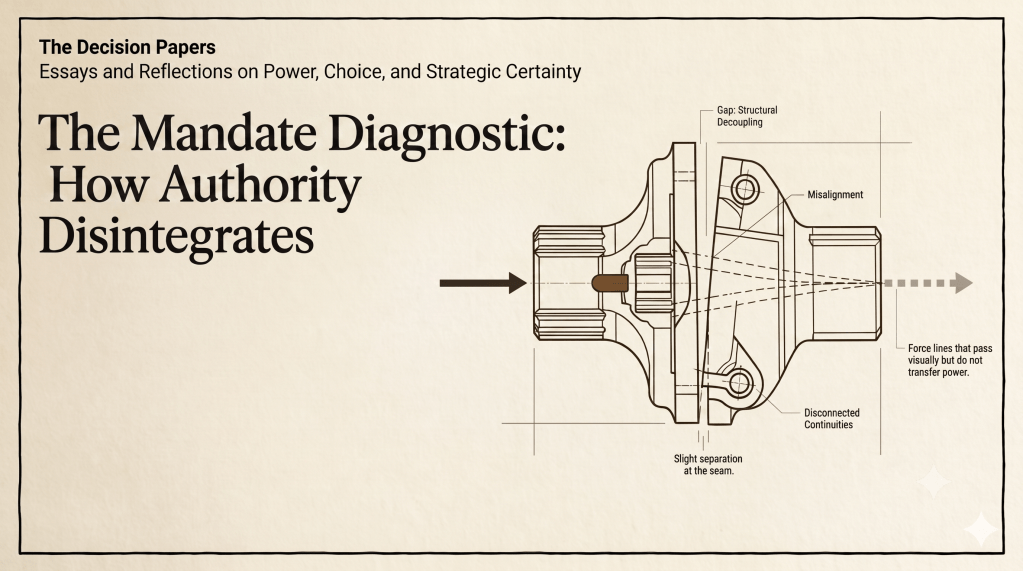
Before you argue about strategy or data, audit the steering column.
A decision is only as strong as the authority of the seat behind it, and authority does not mean charisma, seniority, or persuasion. It means binding power: the explicit right to commit the institution paired with the liability to carry the consequence. Authority sits upstream of every decision process as a hard joint in the architecture, and when that joint is broken, even rigorous analysis becomes a force multiplier for failure, because it spends authority no seat possesses.
What no one in the room is willing to ask out loud, while the third strategy review of the same problem grinds forward, is whether the failure is in the analysis at all.
Name the principle: authority disintegrates by structure, not by intent.
Mandate failures rarely explode. They leak. They produce decisions that look reasonable, owners who look engaged, and analyses that look thorough, while nothing moves and accountability cannot quite be found when the time comes to find it. The leak is structural, not a matter of weak character or bad faith.
Seal this off from ordinary politics. This is not about people resisting decisions or hoarding power. It is about recurring patterns by which a mandate that exists on paper fails to bind in practice. Liability cannot be destroyed, only transferred or hidden; unassigned, it does not disappear but moves into the system as hidden debt, paid later by people who never signed for it.
The mechanism is that mandates can be present in name and absent in three distinct structural senses, and each leak has its own physics.
A mandate can be uncoupled, the Ghost. The seat exists, the title is real, the ambition is genuine, but the organisation’s real gravity, budget, engineering capacity, priority-setting rights, sits inside other divisions that the seat cannot move. Orders travel outward, but force never returns. The seat becomes a central government issuing directives to provinces that politely acknowledge and quietly subvert them, and the failure is not persuasion but power structure: the steering column is not connected to the wheels.
A mandate can be hijacked, the Proxy. A designated decision-maker still sits in the chair, but a single target, cross-sell, quarterly margin, utilisation, quietly determines which choices are allowed and which are unthinkable. The system calls this discipline; it is often a hijack. The leader becomes a clerk for an incentive machine, and the moment the evidence says the right move requires missing the metric, the structure forecloses it. The seat is still steering; the destination was set elsewhere, long ago.
A mandate can be diluted, the Tourist. Leadership reframed as alignment collapses into distributed veto: no one has the authority to kill the failing product, but everyone has the authority to slow the new one. Participation is healthy; unowned closure is the failure. When everyone can say no, no one can say yes, and mandate dissolves into a posture with no liability attached.
The cost is that the institution spends increasing energy on decisions that never close, and the failure is filed under everything except what it is.
A Ghost produces an executive who works tirelessly and changes nothing, filed under stakeholder management rather than structural disconnection. A Proxy produces a run of rational decisions that all bend toward the metric, and the institution mistakes the bend for strategy. A Tourist produces consensus decks that bind no one, so when the outcome fails no payer can be found. In every case unassigned liability moves into the system as debt no one knows they hold, and the organisation earns a reputation for execution challenges when the real failure was upstream, in mandates that disintegrated years before the symptoms appeared.
The objection is that auditing every authority structure before every decision is itself a paralysis device: the institution stops deciding and starts diagnosing, and every move is delayed by an upstream legitimacy check.
The objection holds against the wrong reading. The diagnostic is not run on every decision; most mandates work invisibly and need no audit, as most steering columns need no inspection. It is triggered by symptoms, decisions made but not landing, accountability sought but not found, the same problem returning under new names. When those appear, more analysis has stopped producing better outcomes, because the failure is no longer in the analysis, and the audit costs less than accelerating into a column no longer connected to the wheels.
In practice, the diagnostic has three moves, each tied to a specific failure pattern, and a fourth move when none of the three repairs is available.
Where the mandate is uncoupled, reconnect resources to the seat: budget authority, priority-setting rights, and reporting lines must flow into the seat that owns the outcome, because a seat that cannot move resources owns nothing and the title is decoration. Where it is hijacked, name the metric that captured the will and install a time-bound, documented override, or the proxy keeps dictating choices the leader believes they make freely. Where it is diluted, force formal closure that names the single seat that pays if the outcome fails, not a committee; if you cannot name that seat, you have not named the owner, and unowned closure produces only the appearance of decision.
The fourth move is the safety clause, for when none of the three repairs is available in time. If the column cannot be fixed and the decision cannot wait, downgrade it: contain the immediate risk, escalate the structural issue to the seat that can repair it, and refuse any irreversible commitment on a mandate that is not standing. An unowned decision committed under pressure becomes an unowned consequence later.
So before you argue about analysis, audit the joint that the analysis is meant to serve.
Repair the column, or downgrade the decision until you can. Acceleration through a broken joint does not produce arrival; it produces collateral damage authored by no one.
Authority rarely collapses at once; it disintegrates joint by joint, and a decision forced through a broken joint inherits the break.
Decision Rule — The Mandate Diagnostic
When decisions stop landing and the same problem keeps returning under new names, audit the joint upstream of the analysis. Match the move to the failure pattern.
- Reconnect the Ghost. Where the seat is uncoupled from resources, restore budget authority, priority-setting rights, and reporting lines into the seat that owns the outcome.
- Override the Proxy. Where a metric has captured the chair, name it explicitly and install a time-bound override condition, so the proxy can be set aside when the evidence requires.
- Close the Tourist. Where mandate has diluted into distributed veto, force formal closure that names the single seat that pays if the outcome fails.
- Downgrade if you cannot repair. When the joint cannot be fixed in time, contain the immediate harm, escalate the structural issue, and refuse to make irreversible commitments on a mandate that is not standing.
When the column is broken, repair the joint or downgrade the decision; never accelerate into authority no seat will sign for.


Leave a Reply