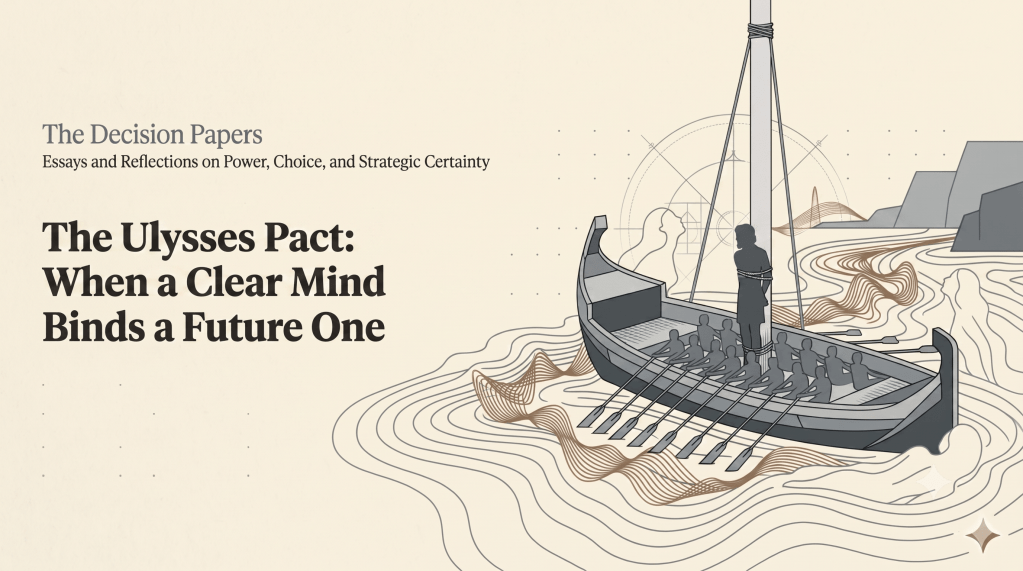
“Bind me as I stand upright, with a bond so fast that I cannot possibly break away … and if I beg and pray you to set me free, then bind me more tightly still.”
— Homer
On his way home from war, Odysseus must pass the Sirens, whose song is so beautiful it overwhelms judgment. The danger is not a monster he can fight. It is a voice he will want to obey.
Here is the part most accounts of willpower miss. Sailors who hear the song do not freeze. They become decisive, turning the wheel with conviction, straight toward rocks hidden beneath the waterline.
The song does not remove agency. It replaces it with a counterfeit: certainty with no contact with reality. The captured man does not feel weakened. He feels clear, he feels right. The question for any leader who understands this is not how to be strong enough to resist, but what to do about the fact that, under the right stimulus, you will not be the person reasoning about it now.
Name the instrument: a Ulysses Pact, a commitment made by a clear mind to bind a future compromised one before the moment of compromise arrives.
Odysseus does not tell himself he is strong enough to resist. He concludes something more humbling: under that stimulus he will not be himself, and because he is captain and king, the compromised self will hold full authority to steer the whole enterprise onto the rocks while believing it is saving everyone aboard. So he builds a structure in advance that will hold when his judgment will not.
Seal this off from willpower, the instrument most leaders reach for and the wrong one. Willpower tries to win the argument with your future self in the moment it occurs, and it loses, because the compromised self does not arrive announcing its compromise. It arrives articulate, confident, urgent, clothed in the full authority of the office. A pact does not try to win that argument; it ensures the argument never reaches the wheel.
The mechanism has two distinct parts, and the distinction between them is the entire lesson.
First, Odysseus protects the operators: the crew seal their ears with beeswax so the signal never reaches them, free to work the ship with steady hands while the seduction passes them by. Second, he constrains the authority: he orders the crew to bind him to the mast, fully exposed to the temptation but stripped of the power to act on it. He wants to hear the song; he refuses to let hearing it become permission to obey.
Then he adds the clause that turns a gesture into a pact: no matter what he says once the song takes hold, the crew must not release him until the danger is behind them. He is pre-authorising his own refusal, deciding while clear that his future self cannot be trusted to decide at all. Inside the range he does not plead weakly, he commands, reasons, threatens, pulls rank. The crew obey not the man in front of them but the decision made by the man who was still himself an hour earlier.
The cost of having no such pact is that the most consequential, least reversible commitments get authorised by precisely the state least qualified to authorise anything.
A leader without a pact locates authority in whoever holds the title at the moment, which means the captured self, urgent and certain and wrong, carries the full power of the office exactly when its judgment has been replaced by a counterfeit. The reputational wager, the public accusation, the escalation that cannot be walked back, each can be committed in the minutes the song plays, and each binds the institution long after the leader returns. This is how a single distorted hour rewrites a reputation built over decades.
The objection is serious and must be answered: pre-commitment is dangerous precisely because the future self might be right, conditions change, new information arrives, and a leader bound by a crew instructed to ignore his present command has built a machine that overrides genuine reconsideration along with compromised impulse.
The objection holds against a pact that binds everything, and a sound pact binds almost nothing, one pre-named line under one pre-named condition. The crew may not override the captain on the thousand decisions the voyage requires; they may refuse exactly one thing, for as long as the distorting condition holds. Genuine new information arriving outside the capture reaches a clear mind normally and is acted on. What the pact refuses is only the argument from inside the capture, urgent, articulate, indistinguishable from clarity.
In practice, building the pact means settling three things while you are still clear, so they are already binding when the distorting moment arrives.
Name the line: the specific irreversible action, reputational, public, financial, or strategic, that must not be taken under pressure, defined concretely enough to be unambiguous in the moment. Define the trigger: the state that signals the distorting situation, the fury, the euphoria, the panic, that tells you the song is playing, because the pact must activate on the condition, not on your in-the-moment judgment. And authorise the crew: specific people granted standing power to hold your prior decision over your present command, and to refuse release until the danger passes, even when you are articulately commanding them to let you go.
The crew can be as small as one, and the simplest is the night itself: no irreversible decision executed until it has survived a full cycle of sleep, because a commitment that cannot live through the dark was never a strategy, only a state. The pact works only because it was built before the song began. The leader who waits until he feels the pull has already lost, because by then the builder is the self the pact was meant to constrain.
So before you enter the water where your mind stops being your own, draw the line, name the trigger, and hand the rope to someone instructed to ignore the version of you that will beg to cross it.
Build the mast in clarity, and let it hold when clarity is gone.
A mind that is clear now can protect a mind that will not be; the pact binds the future self to the judgment made before the storm arrived.
Decision Rule — The Pact Protocol
Before entering any high-stakes situation that will distort your judgment, bind the decision while you are still clear by settling three things in advance.
- The line. Name the specific irreversible action, reputational, public, financial, or strategic, that must not be taken under pressure, defined concretely enough to be unambiguous in the moment.
- The trigger. Define the state or condition that signals you have entered the distorting situation and the pact is now in force, so it activates on the condition, not on your in-the-moment judgment.
- The crew. Authorise specific people, or the night itself, to hold the prior decision over your in-the-moment command, and to refuse release until the danger has passed.
If you are arguing, in the moment, to cross a line you drew in clarity, the pact governs, not the argument.
Honour the decision made in clarity, not the command issued under pressure.


Leave a Reply